Easter Eggs

Easter eggsEaster eggs have been used by Christians since the first century to symbolize the significance of Easter for several important reasons. Eggs have always been a symbol for new life, and the hope which that new life brings. Eggs symbolize that, with our creating, resurrecting God, new, inexplicable, indescribable, life is always cracking open. Eggs symbolize the truth that with our creating, resurrecting God, our best days of life are always ahead of us.

There is much evidence that the early Christians saw the egg as a symbol of immortality.  Archaeologists believe that Christians in the first century met on Easter at the tombs of deceased Christians, and they ate a meal called a re-frig-ria. In fact, at the supposed tomb of St. Peter in Rome, when excavations were undertaken during the last century, piles of egg shells were discovered. Throughout the centuries, Christians have gathered in cemeteries on Easter Sunday morning to eat breakfast, to eat eggs, a sign of eternal life.

This leads to a more profound way I believe eggs symbolize Easter. Read John 21:12-25 NRSV.

When does the risen Christ appear to the disciples? He appears at breakfast. Why is this significant?  I will tell you.

Few of our meals are more ritualized, more predictable, and more routine than breakfast.  Some of us eat the same thing for breakfast every morning. It is the most ordinary meal of the day.  Yet, this is the time and the place the risen Christ meets his disciples. During the most ordinary time and place, the disciples experience the risen Christ and hear his call.

The good news is the risen Christ may appear to us on a very special Easter Sunday morning in a very extraordinary worship service; however, if we pay attention, he might also appear to us on a very ordinary Monday morning at home around a mundane breakfast table.

Grace in Galilee

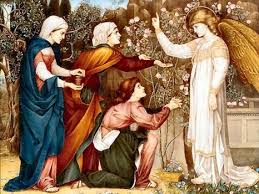
easter angel

Mark 16:1-8 NRSV

The messenger tells the women at the tomb, “Go, tell his disciples—and Peter—that he is going ahead of you to Galilee’ there you will see him, just as he told you.”

What a peculiar thing to say. What does he mean “the disciples and Peter?”  Is Peter no longer a disciple? That’s like someone saying, “Go tell the choir—and Harold.”  When was Harold ever not a part of the choir?

Go tell the disciples—and Peter.  It would be, of course, fair to assume, that on this first Easter Sunday morning, Peter just might be outside Jesus’ circle of trust.

When Jesus is arrested in the garden of Gethsemene, John tells us that it was Peter who protested by drawing his sword and cutting the ear off the slave of the High Priest. Jesus chastises Peter and heals the man’s ear.  In this action, Peter proves that he has missed the whole point of Jesus’ ministry and purpose.  All throughout his ministry, Jesus spoke of turning the other cheek, laying down one’s life, losing one’s self, dying to self, and loving one’s enemies, and here is Peter, at the end of Jesus’ ministry, demonstrating that he doesn’t have a clue who Jesus is or what his Kingdom is all about.

Then after Jesus is arrested and taken to the high priest, Marks says that Peter followed behind at safe distance, right into the courtyard of the high priest where Jesus would be tried. He sat outside with the guards, warming himself at a fire when this servant girl of the high priest stares at him.  She then approaches Peter: “I know you. You were with Jesus, the man from Nazareth.”  Peter denies it saying, “Girl, I don’t know and I don’t even understand what you’re talking about.”

Then Peter, trying to save his own skin, tries to make an exit.  This one who has been taught that those who try to save their life will lose it, slips out into the forecourt. A cock crows.

The same servant girl followed him and started talking about him to all the bystanders saying, “This man is definitely, one of them.”  But again, Peter denied it.  Then, it is one of the bystanders who goes up to Peter and says, “I know you’re with that Jesus, because you’re not from the city, you are from the country, you’re a Galilean.”

Then Peter, this disciple of Jesus, this one who has been taught by Jesus to do unto others as he would have them do unto him, this one who has been taught that the greatest commandment is to love one another, curses at the innocent bystander.  And then, this one who was taught by Jesus to never swear with an oath, let your yes be yes an your no be no, always be honest and truthful, lies again, this time emphatically, by swearing an oath, “I told you that I don’t know this man that you are talking about.”

And that moment, Mark says, the cock crowed for the second time.  Then Peter remembered Jesus’ words to him, “Before the cock crows twice, you will deny me three times.”  And he broke down and wept.

So of course it is very fair to assume that Peter is now way outside the circle. Simon Peter simply never got it. He never got the point of understanding who Jesus was or what his Kingdom was all about.  Peter was as dumb at Easter as he was at Christmas.  One could say that he was a complete failure at being a disciple.

And what maybe worse, he was a failure and he knew that he was a failure.  That’s why we find him at the end of Mark’s story crying like a baby.

“Go tell the disciples and Peter—this has-been, washed-up and flunked-out disciple who is far, far outside my circle.”

Now, it would be easy to believe this interpretation if it wasn’t for one important fact.  All of the disciples were flunkies.  In the Gospel of Mark, none of them get it.  After Jesus was arrested, while Peter was following the soldiers and Jesus into the courtyard of the High Priest, where are all of the others?  Read verse 50 of chapter 14.  “All of them deserted him and fled.”

They’re all losers. They all cared more about their own lives then they did Jesus.  And not only that, even the women in Mark’s gospel, the women who always appear in the gospels to be just a little more astute than the men, even the women do not seem to get it.  “Go tell the disciples and Peter that he is going ahead of you to Galilee; there you will see him just as he told you.”  And what did they do? “Go, tell,” said the angel.  Read verse 8:  “and they said nothing to anyone.”

No, in saying, go tell the disciples and Peter, the messenger of God was not inferring that Peter was outside the circle. God was saying that Peter, despite everything that he had done, despite everything that he hadn’t done, despite his stupidity, his failings, his denials, Peter was still very much in the circle.

The angel was saying: “Go tell all the disciples that Jesus has be raised for them, and please, especially tell Peter. Tell him to dry up his tears in spite of all of his sin, his failure to follow Jesus, and his denials.”

Jesus is alive for all, maybe more so for Peter.

“Please let this one who feels like an outcast, who feels so much outside the circle of God’s love, that if Death could not separate him from Jesus love, his sin and his denials were certainly not going to do it. Jesus is alive for all of the disciples, and even, especially Peter, especially this one who realizes his failure. Jesus is alive for even Peter, and the good news is, even for you and for even me.

Go tell the disciples and Peter. It is not a peculiar thing to say. It is good news. It is not odd. It is amazing. It is good, amazing grace.  It is the good, amazing news of Easter. God offered us the very best that God had to offer, the gift of God’s self through Jesus Christ. We reciprocated that gift with the worse that we had to offer—the cross.  And yet, God still raises Jesus from the dead and sends him back to the very ones who nailed him to a tree.

Now, let me tell you what’ really odd about this text. “Go tell the disciples and Peter that he is going ahead of you to Galilee.”  To Galilee?  Now that’s peculiar. On the first day of his eternal life, Jesus decides not to go to the capital city, not to the places of power and prestige, not to where he could really get some attention, be some breaking news before millions, but he chooses to go to Galilee.[i]

Compared to Jerusalem, Galilee is backwoods, insignificant. Galilee is way out in the country, way out of the way.

One might have thought, that upon being raised from the dead, Jesus would stride triumphantly back into Jerusalem. Imagine what a stirring sight that would have been. Jesus could have strolled right into the palace and said, “Pontius Pilate, I am afraid you’ve made a big mistake.”  Or he might have stood on the steps of the temple, chiding the crowds for their fickleness and betrayal, showing himself to the multitudes that were present when he was crucified.

Jesus, however did none of that.  Rather, he went on ahead of his own disciples to meet them back in Galilee.

That is, Jesus will meet his disciples in a rather ordinary place, a place where their discipleship began. Jesus had come out to where they lived, out to Galilee. They had attempted to be his disciples mostly in Galilee. It was in Galilee where they left good paying jobs, their families all forms of security to follow Jesus.

In Jerusalem, they had betrayed and deserted him.  Back home, in Galilee they accepted and followed him.

And Jesus goes back home—to Galilee. The failure of the disciples, the denial of Peter, the disobedience of the women, none of this is the end of the story. A fresh start can be made, and where will this new beginning be? Where is the risen Christ? Back where it all began, back home in Galilee.

The good news of Easter is that in spite of our sins, our failures to follow him, our denials and betrayals, Jesus is alive—Jesus is on the loose—Jesus is moving.  Where?  Out in Galilee.  He’s out where the disciples live. He’s out where you live and I live. At home, out in Galilee.

The risen Christ always appears to the disciples in the most ordinary of places: at breakfast, on the beach, while they are at work.  Something about the risen Christ loves to meet people in the most ordinary places.  That’s good if you want to meet Jesus, because most of us live and most of us work in ordinary places, like Galilee.

Go tell the disciples and especially Peter that Jesus is going ahead of them to Galilee. And, there in Galilee, there in a most ordinary place, you will find grace.

Go tell these sinful, selfish, human beings, these very ordinary fishermen, even this one named Peter who thinks I have forsaken him, that I am going ahead of them, back to the place where it all started.  Forgiveness of sins, a fresh new beginning, a brand new start is available where?  In the most ordinary of places—at home, where you live, where you work.

The good news is that no matter what we have done, no matter who we are, even if we are just as dumb at Easter as we were at Christmas, Jesus lives for us. And we don’t have to go anywhere special or do anything special to meet him. He’s gone on, ahead of you, ahead of me.  He’s gone to where we live.

The good news of this day of days is that we, even sinners like us, can go home today. We can go back to our homes here in Farmville, in Fountain, in Wilson, Tarboro, Greenville, Winterville, New Bern, we can even go down back into Greene County, and there, wherever we go, in our most ordinary place, we will find that Jesus is already there, enveloping us with grace, filling our hearts with love with love, giving us a fresh new beginning, a brand new start.

So, go!  Go home. And begin living the first day of your eternal life.


[i] Inspired from William Willimon, He Came Back to Us .(http://www.northalabamaumc.org/blogs/detail/177), 2008


Good News in the Disappointment of Holy Week

holy week crown

It is two-thousand years later, and we are still surprised, confused, and even somewhat disappointed. Shattering our expectations of a Savior, King Jesus enters the city this week to liberate his people riding a borrowed donkey with an army of rag-tag students who have no idea what they are doing.

God’s throne is not made of silver and gold. God’s throne is made of wood and nails. God wears not a crown of jewels, but a crown of thorns.

When God chose to save the world from sin and evil, Jesus exercised a peculiar kind of power. It is not the type of power that we are accustomed to or desire. It is not a power that rules but is a power that serves. It is not a power that takes but is a power that gives. It is not a power that seizes but is a power that suffers. It is not a power that dominates but is a power that dies.

And we are still surprised, confused and somewhat disappointed.

“O God, though I attend and support my church every Sunday, why do my prayers seem to go unanswered? Why do I still struggle with life?”

“Dear Lord, We have been serving you our entire lives, faithfully giving you all that we have! I do not understand why you have not brought physical healing to my wife who suffers daily with a chronic disease.”

“Heavenly Father, we try our best to respect and love all people. That is why I am somewhat dismayed that you allow others to call us names, ridicule us and cause us pain.”

“And yet, Lord, in my astonishment, bewilderment and disappointment, you come to me nonetheless. Although I have no idea I am doing, you envelop me with your grace. You come to me in all of your glory and with all of your power. You come serving, giving, suffering and dying. You come offering me the very best gift that you can possibly offer—the gift of your peculiar holy self.”

And the good news is: that is more than enough!

Holy Week

holyweekSometimes it seems odd to call this week “Holy.”

The week that begins on Sunday with our Savior’s triumphant entry into Jerusalem ends with his death on a cross at a place called “The Skull. Shouts of “Hosanna!” on Sunday quickly turn into shouts of “Crucify Him!” by Friday.

Every imaginable evil is hurled his way. The powers that be, both religious and political, are ready to entrap and ensnarl him. He is betrayed by one of his very own followers with a kiss for thirty pieces of silver. After his arrest and a hasty trial, his disciples all abandon him. One of his closest friends on earth denies that he even knows him.

Then, deserted by his friends, Jesus is ridiculed, spat upon, utterly humiliated and beaten beyond recognition. A crown of thorns is put on his head, and he is forced to carry his own cross. His hands and feet are nailed to the cross before it is lifted into the air where he hung for six hours between two criminals before dying. The week ends with his burial.

What on earth is “holy” about any of these events?

The answer is a simple one. If Jesus is an ordinary man, then the answer is, “nothing.” If Jesus was but a man, then this week is utter tragedy. However, if Jesus is the Incarnate God, the creator of all that is who became one of us, then the answer is “everything!”

For it means that God understands every aspect of what it means to be human. Our God is a God knows something about every imaginable evil that can be hurled our way. Our God knows betrayal, abandonment, humiliation, loneliness, and immense suffering. Our God has experienced death.

This week means that our God understands.

And three days later, an empty tomb reveals that God redeemed it all! God took the evil hurled God’s way and transformed it, recreated it into something wonderful.

Thus, the good news of this week is that not only has God experienced all of the evil of this world and understands (which would be good news enough), but that God takes that evil and transforms it into something wonderful, something profoundly “Holy.”

Dance Like Fools (Reflections on King David and John the Baptist on April Fools’ Day)

old-guy-dancing

2 Sam 6:1-5, 12b-19 and Mark 6:14-29 NRSV

After King David led a great army to return the Ark of the Covenant to Jerusalem, David and his army were so overcome with emotion that they engaged in festive dancing.

The scripture tells us that David danced before God“with all his might.”  He danced before God with all that he had and with all that we was, as he was utterly and completely overcome by the joy of God.

However, in this broken world there is always something or someone ready to burst our bubble of joy wide open.  So it was with David.

When David and his wife Michal arrived home from the party and began preparing to turn in for the night, David, if he was anything like most men I know, was probably expecting to hear some words of affirmation from his wife. “Honey, as I watched you dance this evening, you just don’t know how proud I was of you!  You danced your heart out!  And why shouldn’t you have, you brought the Ark of the Covenant back to Jerusalem where it belongs!”

However, the words David hears instead were something like: “Baby, you really made a fool out of yourself tonight!”

Perhaps David did act like a fool. Uninhibited and unrestrained, he lost all self-control.  Seized by “a spirit of prophetic ecstasy,” that night David held absolutely nothing back. David gave in to the joy which had consumed him. He had completely surrendered himself to the joy of God.

David danced, affirming the rule of God.  David danced, consumed by the joy of God. David danced a dance of total self-surrender. David danced, holding nothing back. David danced giving all that he had and all that he was to God.  And Michal despised David for it.

This is the harsh reality of living the gospel of Jesus Christ. The dance of the gospel is a dangerous dance. The dance of the gospel is a disturbing dance. The dance of the gospel is a dance which is despised by the world. The active affirmation of the rule of God does not set well with the Michals and Herods of the world.  In fact, people are likely to lose their heads if they claim too much for the gospel.

To metaphorically call the life and ministry of John the Baptist “a dance” does not call for a stretch of the imagination.  Like David, John the Baptist had lost all restraint, inhibition and self-control.  John the Baptist held absolutely nothing back.  He had surrendered himself completely to the rule of God.  And in the eyes of many probably acted like a fool. The joy of God consumed him. One could say that John the Baptist was seized by a spirit of prophetic ecstasy.  Everything about him: his dress, his speech, even his diet was an uninhibited dance of joy.  He had given all that he had and all that he was to God. And his head was served up on a silver platter.

The dance of prosperity preachers are easier steps to follow, aren’t they? The message of false prophets distorting the gospel of Christ as nothing more than a little dose of “chicken soup for the soul” is much easier to swallow. If we just get ourselves right with the Lord, if we would just straighten up and pray right and live right, good health and great wealth will come our way.

The dance of the gospel is radically different. The dance of the gospel contains steps to the beat of a different drum. If we get right with the Lord, if we pray right and live right, if we lose all inhibitions and all restraint, if we completely surrender ourselves to the rule of God, if we love others as Christ loves thereby allowing the joy of God to consume us, to control us, then suffering is inevitable.

If we dance to the beat of this drum, in the eyes of the world we can expect to look like a fool. For the dance of the gospel is a dance of self-surrender to a very radical drum beat. It is a beat of sacrifice. It is a beat of selflessness. It is a beat of self-expenditure. It is a beat of love and of grace.  And to world, as the Apostle Paul warned the Corinthians, if we let go and dance to this beat, we are certain to look pretty foolish.

The world may call us fools when offer our friendship to a poor, lonely, childless, widow as we visit her in the nursing home on a regular basis.

The world may call us fools when we prepare and deliver a meal to someone recovering from surgery, especially when that someone has always treated us with condescending contempt.

We may look like fools to the world when we spend valuable time volunteering at the hospital, serving lunch in a soup kitchen, visiting someone in prison or working in a homeless shelter.

The world may call us fools when we offer love and forgiveness to our enemies, when we give the shirt off our backs to complete strangers in need.

The world will call us foolish when we give sacrificially and consistently to the budget of a local church.

And the world will call us foolish anytime we love anyone with the self-expending love of Christ—whenever we love someone without inhibitions, without restraints, and without reservations.

I believe this is the dance of the gospel—a dance of immense joy, but also a dance of enormous suffering.

And the Herods and Michals of the world despise this dance.  And they will do everything in their power to stop this dance.

We have all heard their voices, echoes which discourage such dancing.  “Don’t get too close to him.  Do not give your heart to her.  As human beings they will only let you down.  They may one day betray you.  They might move away.  One day they will die.”

“Don’t love that man.  He has done absolutely nothing to deserve it.  And will probably never be able to reciprocate.  Don’t love that woman.  She is poor and destitute.  She is too needy.  She will demand too much.”

The voices Michal and Herod say: “Don’t give yourself away to another.  Loving like that is too risky.  It leads to too much pain, heartache and grief.”

However, there is another voice.  A voice which was heard by David and by John the Baptist.  It is a voice which says: “Dance!  Hold nothing back.  Give yourself away. Surrender yourself to beat of the heart of the gospel.  Love.  Love honestly and deeply.  Love courageously and graciously.  Lose yourself.  Empty yourself.  Pour yourself out.”

Will this love cause pain?  It will cause enormous pain.  But the joy of God which will consume you will be so immense the suffering will be well worth it.  So, dance.

Garth Brooks once sang a song entitled “the dance.”  There’s a line in that song that goes, “I could have missed the pain, but I would have had to have missed the dance.”

Loving others will inevitably bring pain.  However, never loving to avoid that pain is never really living.  There is no joy being a wallflower on the wall of life.

So, may we dance!  May we go out and dance in the streets of our world!  Let us go out and have seizures of prophetic ecstasy!  Be warned, we might look like fools, and we will suffer for it. However, the immense joy of God, the joy of abundant life, now and forevermore, is well worth it.

Getting Our Hands Dirty

John 9:1-41 NRSVdirty-hands-medium-new

Let’s think for a minute what it did for this poor blind man when the disciples began a theological debate over his blindness.

“So, they say you were born blind? Well, let get out our Bibles and see if we can find some theological reason for your blindness. It has to be because of sin. But since you were born blind, perhaps it’s not your sin that is to blame but the sins of your parents.”

Yes, I’m sure all of that theologizing and rationalizing did a whole lot for that poor man.

But how often have we’ve been guilty of doing the same. For some reason, because we are religious, or at least, spiritual people, we believe it is our ordained duty to try to explain human suffering and misery in light of our faith in God.

When the earthquake and Tsunami struck Japan a few years ago, like the Tsunami that struck Southeast Asia years before, I heard some preachers say that it is because Japan was not a Christian nation.

When terrorists destroyed the World Trade Center Towers on 9-11, they said that corporate greed was to blame.

When Hurricane Katrina devastated New Orleans and Gulfport, I heard some blame it on all the new casinos that had been built in the region.

And whenever there is an outbreak of strong storms, tornadoes, wildfires or landslides, I have heard plenty of Christians say, “God must be trying to get our attention!”

For whatever reason, when suffering occurs, we believe God must have had some pretty good reasons to allow it.

In the face of human pain and suffering, there are two predominate explanations that are usually given by the church.

The first one is the one I usually hear from the TV evangelists and conservative pulpits. God is sitting at the command center in complete control of every earthly thing that happens. God has got a plan for the world, and it’s a good plan, but we as limited human beings may not always be able to figure that plan out. Who knows? Maybe people who suffer deserve to suffer. But we do know this: God’s judgments are always just. You just have to have faith and believe. You have to trust that God has his reasons, has his driving purposes for everything that happens.

The other response comes from more liberal scholars. And that is one of silence, just silence. God is large and God is indescribable. Life, and the suffering that comes with it, is utterly mysterious. We simply have no answers to our “why” questions—silence.

Frankly, I believe both of these responses are terrible, to say the least. First of all, those who believe God has some kind of divine, driving purpose for every evil thing that happens in this world, in my estimation, paint a very evil and anti-christ portrait of God.

And those who respond with silence, those who refuse to say anything at all in response to human suffering, make God out to seem detached and aloof. God is watching us, but from a distance. Thus, God is reduced to this a mysterious abstraction devoid of any real meaning.

However, the gospels paint a very different image of God through the words and works of Christ. I believe the life, suffering and death of Christ teach us that when the landslide shook the earth in Washington, so quivered the very heart of God. As the earth rolled down and toppled homes and lives, so rolled down the very tears of God. As the lives of many were suddenly were poured out, so emptied the very self of God. God was not causing the evil. Neither was God silent.

This is where I believe our Gospel lesson this morning is especially helpful. When Jesus is questioned about this man’s lifetime of pain and suffering by his disciples, Jesus really doesn’t answer the question, but neither is he silent. Jesus responds by pointing out that this was a good opportunity, not for theological debate, not to assign blame or responsibility, but rather, to bend to the ground, spit in the dirt, and get his hands dirty, so that the glory of God might be revealed. Jesus responds to human suffering and misery by bending to the ground, getting his hands dirty to bring about healing and wholeness.

And with that, a huge argument ensues. But notice that Jesus refuses to engage in the argument. Jesus is not interested theological debate or speculation. Jesus is interested in simply being there with the man, touching the man, thus revealing the peculiar glory of our God and power of out God.

When I was in college, one of my favorite professors was Dr. Bobby Bell. During my junior year, Dr. Bell was diagnosed with a terminal cancer. I had the wonderful opportunity to take what would be his last class. He was a sociology professor; however, he would often share his faith in class.

ll never forget the time when one of my classmates asked Dr. Bell if he ever felt that God had some reason for allowing his cancer. “

God did not give me this cancer. I am a human being. And human beings sometimes get cancer. I have cancer because I am human, and not for any other reason. I don’t believe for a minute that God wants me or anyone to have cancer. That’s why I believe during this time of suffering and pain, I have sensed, in a way that I have never sensed before, the very intimate, near presence and love of Christ in my life. And I may not be healed physically, but I have certainly felt the hand of Christ on me and know that I have been healed spiritually. I believe the living Lord is here suffering with me, and that means everything in the world to me.

Dr. Bell died two days before final exams. But there’s no doubt in my mind that he died a healed and a very whole man.

I think it is interesting that the great Southeast Asia Tsunami hit the day after Christmas. One of the world’s worst natural catastrophes took place the very first day after the church’s celebration of the Incarnation, the celebration of the good news that our God did not remain silent, aloof and detached from us. The celebration that our God became flesh and came among us; our God is a God who descends; our God is a God who bends, who stoops to the earth.

The story of this healed blind man comes in the same Gospel of John that begins, “In the beginning was the Word…and the Word was made flesh and moved in with us…and we beheld his glory.” The great, grand glory of this God who became flesh with us, is not that God is in complete control of everything earthly thing that happens, and it is not that God has an explanation or a reason or a driving purpose for everything that happens to us, but rather that God is here with us.

In the face of suffering, our God reaches in and reaches out to us, bends himself to the ground, gets God’s hands dirty and touches us.

Every year when Holy Week approaches, I think about the worshippers of the Goshen United Baptist Church in Piedmont, Alabama. It was Palm Sunday in 1994. About midway through the worship service at 11:35 am, as the choir began to sing, a tornado ripped through the church building destroying it completely. Eighty-three out of the 140 worshippers who attended the service that day were injured. Twenty-one worshippers were killed. Eight of the dead were little children—children who had just walked down the aisle carrying their palm branches.

There was absolutely no driving purpose, no theological explanation for that tragedy, except for the fact that we live in fallen, broken, unfair and sometimes senseless world where tornados, landslides, tsunamis, hurricanes, and cancer can develop and arbitrarily destroy.

Thankfully Christians from all over the world responded to that great tragedy by emulating our God revealed to us in Christ, by bending themselves to the ground, getting their hands dirty, raising that church out of the rubble. Christians everywhere imitated their Savior by suffering with and being with the grieving.

On the church’s website today, you will find these words:

 After the tornado, we received many gifts from all over the world. They lifted us up and helped us to know that we are not alone. Among those gifts were a banner and a painting of Jesus walking on turbulent waters. These and other gifts are reminders that God is with us through our storms, and with His help we will rise above them and be stronger because of them. We can now affirm the truth of the message that is contained on a plaque and in the words of a song: ‘Sometimes God calms the storm. Sometimes, he lets the storms rage, and calms the child.’

The good news is, as the Psalmist so beautifully describes it in the 23rd Psalm, God is always there to calm God’s children.

And in the end, isn’t that much better than any theological explanation?

When Death Surprises Us

Surprise_Surprise

Memorial Service for Florence Styers, March 17, 2000

Death is always painful.  Losing someone you love is always tragic.  However, the pain and tragedy of loss seem to intensify when it takes us by surprise.  It leaves one in a state of shock, a state of disbelief.  Numb.  There are some times when our hearts break slowly over time, and then there are those harsh times when they break very abruptly.  This is what happened to my heart on Grimmersburg Street on Tuesday evening.

There is nothing good about death. It marks the end of life on this earth. It is our last great enemy. And it separates us from the ones we love. Death is always a tragedy.

We can try to comfort ourselves by saying things like “Our loved one is better off than we.” “She is in a far better place.”  “At least she did not suffer.”

 But at the same time, we cannot help to selfishly ask:

“If she was so healthy, why couldn’t we have her here ten, even twenty more years.”  “What was so bad about the place she was—here with us, in the presence of the ones she loved and with so many who loved her?”

No, the truth is: there is nothing good about any death.

And it seems even harsher when it surprises us. Because the truth is we do not like the surprises of our fallen world.

We do not like the world’s surprises because they do not fit into our plans.  They disrupt our lives. They cause confusion and chaos. And our fallen world is full of them. Tragedy and catastrophe, sickness and disease, wars, storms, floods, and earthquakes stalk our earth continuously ready to jump out and overtake us when we least expect it. And so it often is with death.

However, the good news is, as our fallen world is full of surprises, so is our God. Our God is a God of surprises.  However, God’s surprises are not tainted by sin and evil, but are shaped by love and by grace. In the garden, God surprised Adam and Eve as God took garments of skin, and with God’s own hands crafted together clothes to cover their shame. Although they deserved to die, God clothed them, enveloping them with grace and forgiveness and love.

If one has heard it only once, one cannot forget the story when God told Abraham and Sarah they were going to have a baby in their old age whose descendants would give birth to Israel. Do you remember Sarah’s response? She laughed out loud. Sarah blessed laugh of the surprised.

And in this Lenten season, as Christians, we know how through Jesus, God once again surprised humanity as he became one of us. God surprised us by offering us the very best he had to offer: God’s only Son Jesus Christ. And when this fallen world rejected him, by humiliating him, by stripping him, beating him and crucifying him to a cross, God surprised us yet again by bringing him back to life and offering him to the very ones who denied, betrayed and killed him.  And promising eternal life through resurrection to all who follow the risen Christ.

And the good news is God still surprises us today by transforming our darkness into light, our despair into hope, our sorrow into joy and our deaths into life.

As we were all surprised this past Tuesday, just think of the surprise that Florence Styers’ received!  There is an old hymn which reads:

Just think of what it must be like to step on shore and finding it heaven,

of taking hold of a hand and finding it God’s hand.

Of breathing a new air and finding it celestial air,

of feeling invigorated and finding it immortality,

of passing from storm and tempest into an unbroken calm,

of looking up and finding it home. 

What a great surprise!

And until that day comes when we will meet Florence again, as God will surprise all of us in a twinkling of an eye with the gift of resurrection, we can count on God surprising us in many ways. 

Memories of our loved ones are a gift of grace. I believe God will surprise all of us the rest of our lives with the wonderful memories of Florence Styers . When our days are difficult, and when our days are long, when we have those despairing moments of grief (and because we loved  Florence we will have those moments), I believe it is then when God will surprise us with those precious memories of Florence’s delicate smile, her warm touch, her soft humility, her tender compassion and her faithful service. I believe God will use those memories to surprisingly touch those places within us that most need touching and renew our spirits—giving us the strength to continue our lives until we meet Florence and God one day face to face.

We will never forget the way in which she lived her life.  Someone told her children recently that Florence lived until she died. We will never forget the contributions she made to this community, through her job, through serving Meals on Wheels, and through her church. 

On Monday when she came to the office to write some checks as our church treasurer, as she did faithfully each week, she told me how she would soon be eighty.  I was shocked.  Surprised.  I told her I would not have been surprised if she told me she going to be 67.  She said the secret to staying young was staying busy. And that she did. I cannot tell you how many times people have come into the office this past week asking me questions which my response has been, “I don’t know the answer to that question, that is something Florence always took care of.” 

And you know when I think about her age, I should not have been surprised on Monday when she told me she was going to be eighty. Even God would have needed at least that long to create someone as lovely and as faithful as the Florence Styers I knew and loved. 

Yes, when we are surprised by the harsh surprises of this fallen world, when our hearts break abruptly, we can count on God surprising us with these great memories of Florence, renewing our spirits. 

And I believe God will continue to surprise us through our loved ones, our friends and our family, and our church.  Those days when we most need it, I believe God will send us an unexpected word of encouragement, an unanticipated visit, and an unforeseen embrace. God will startle us as the people of God around us will make us laugh like Sarah and Abraham, the laugh of the surprised.

Yes, when we have those moments when we feel we just can’t go on without Mama, without Nana, without Florence, God will surprise us with her memories, God will surprise us with our loved ones, God will surprise us with God’s Holy Spirit and God’s eternal hope.  God’s hope that as God surprised Florence with eternal life, one day God will surprise all of us who call him Lord with eternal life.

Death is hard.  Losing a loved one is painful. There is nothing good about it. And the pain of loss seems intensified when it catches us by surprise. But thank God, God will catch us all by surprise, with his love and with his grace, now and forevermore.

The Problem of the Know-It-All

know it allJohn 3:1-17 NRSV

In today’s gospel lesson, a very knowledgeable and prominent leader of Israel comes to Jesus seeking to discover who Jesus is and what Jesus is all about. The learned and sophisticated Nicodemus begins his conversation with Jesus appearing poised and confident, “Now, we know that you are…”  He begins his conversation from the same place that most of us mature, experienced, educated, long-time religious people often begin our conversations about God—from the stuff we know, from the stuff we understand… or think we understand. “Now we know that you are…”

And it’s from there that the conversation gets all convoluted and confused. Jesus begins talking to Nicodemus about birth, and poor Nicodemus thinks Jesus is talking about ordinary, physical birth. Jesus starts talking about the Spirit—and Nicodemus thinks Jesus is talking about the wind.

It is interesting that Nicodemus comes to Jesus at night, for in just a few brief moments with Jesus, Jesus proves that, when it comes to God, Nicodemus is in the dark in more ways than one.  Nicodemus comes to Jesus confident and assured, but by the time Jesus gets finished with him, Nicodemus is confused and mumbling, “Uh, How can this be?”

Nicodemus has a problem.  And perhaps Nicodemus’ problem is in the very way he came to Jesus in the first place—“Now we know that…”

And maybe that is precisely our problem—“Now we know that…”  We can’t help it.  We are modern, intellectual types who know a lot!  We can explain the inner workings of the atom, the intricacies of the human genome, the formations of tropical depressions, and how to build a space shuttle. We know. We live in what they call the information age. If there’s something we don’t know, we can just Google it, and in a few simple clicks of a mouse, we know. With WebMD and Wikipedia, there is hardly anything that we cannot easily understand and explain.

Perhaps this is why we try to approach God the way we do. God is to be understood and easily explained. 

It is no wonder those on the outside of the church accuse those of us who are on the inside of being “know-it-alls” when it comes to religion.  They believe that we think we have all the answers. There are some that think that we are here this morning because we are experts on religion, knowing lots of things about God. And truth be told, that is exactly why they are not here with us this morning.

One day, I was introduced to someone who knew that I was a pastor. He shook my hand, and said, rather proudly, “I am an agnostic.” Which means that he did not know he believed about God.

I surprised him when I responded, “I have my moments when I am an agnostic too.” I believe that some are agnostic all of the time, and all, if they are honest, are agnostic some of the time.

The reality is that here on Sunday, we acknowledge together how little we really know. We gather ourselves together to acknowledge the great truth, that when it comes to the mystery that is God the Father, God the Son and God the Holy Spirit, we are all, well, quite ignorant!

The truth is that the God we worship is much larger than our imaginations. God is bigger and more alive than we ever can possibly comprehend.

This is why I believe I left the movie, Son of God, feeling disappointed. There is just no way anyone can capture the essence of who Jesus is and present it in a one-hundred and forty-minute cinematic presentation. I told someone that I have been preaching the gospel of Jesus for over twenty-five years, and I have not even begun to scratch the surface of who Jesus is and what the gospel is all about.

William Willimon, commenting on how some reduce God to something we can easily understand said, “You can’t define this God, put this God in your pocket, or on a leash and drag God around with you.  Life with this God is an adventure, a journey, a leap into the unknown, an expectation that, among even the most regular attendees among us, there will be surprises, jolts, shocks.”[1]

In a few moments we are going to have a child dedication service. Robert and Ashley Bishop are going to present their son, Owen. And Brooks and Jenny White are going to present their son, Chase. We are pretty confident that we know what we are doing when we dedicate them to the Lord. We believe that we are merely promising to nurture them, guide them and teach them all we know about Jesus and God and the Holy Spirit. We say that we do this because they are the church of tomorrow.

But what if Owen Bishop and Chase White have more to teach us about the triune God than we can possibly imagine? What if Owen and Chase and every other small child here today are not the church of tomorrow, but are actually the church of today? What if they truly are, as Jesus implies, more a part of this thing called the Kingdom of God than we can ever know? What if we are not so much the ones who are going to instruct them about this journey called faith, as we are the ones who are merely going to invite them to go on this journey with us? And along the way, what if they are the ones who have a thing or two to teach us?

How often have we gathered around this table confident that we know exactly what is going on here around this table. Catholics and some Episcopalians are all so mysterious, always insisting on calling it “Holy Communion.” We like to call it simply “supper.”  Some believe that something mysterious takes place as they eat this meal. They call it transubstantiation. We only believe it is a dry little cracker and tiny sip of Welch’s grape juice and an act of remembrance that is confined to our limited and finite minds. 

But what if there is more going on here this morning than we can see, touch or taste or even remember? When we gather around the Lord’s Table, what if there is more going on here than meets the senses? What if there is some mysterious communion or a very holy fellowship happening here? Sharing what we merely call a “supper,” what if we are surprised to discover that we are somehow invited to join the same fellowship that is mysteriously and inexplicably enjoyed between the Father, Son and Holy Spirit? 

In and around this table, what if there is something afoot, something happening— moving, inviting, healing, strengthening, loving, forgiving, saving, calling, challenging, commissioning?

We have come to instruct and bless children, but we will leave having been instructed and blessed by them. We thought that we have come to remember a life, a death and a resurrection, but we will leave having been caught up in that life and death and transformed by that resurrection.

As Willimon has said, “For, that is our God at our God’s best. That night as Nicodemus talked with Jesus, he began with what he knew. And he ended with questions about what he did not know. He arrived fairly confident that he had a good grasp of, [a good hold on] who Jesus was; [he left surprised,] having been encountered and held by the mysterious, majestic Holy Spirit of God in the flesh.”[2]

This morning, when we awoke, we thought we knew what we were doing. We thought we were going to get up, get dressed and simply go to church, sing a few hymns, have the Lord’s Supper, listen to a sermon, dedicate some children. Then we would leave, get some lunch and come back home unmoved and unchanged, to watch a little more basketball.

However, when got here, we realized that we did not know it all. A song spoke to us, a small wafer and tiny cup filled us, a word challenged us, a child looked at us and blessed us, and God, the creator of all that is called us by name and loved us. Christ came and wrapped his arms around us as his Holy Spirit breathed new life into us. And now, we will leave this place changed, transformed and divinely commissioned to share the love of God with all people.


[1]Quote and interpretation of Nicodemus’ first words to Jesus “We know” came from William H. Willimon, We Know (PR 34/2; Inver Grove Heights Minnesota: Logos Productions, Inc., 2006), 49.

[2] Ibid.

Strength for the Journey

lent and communion

1 Kings 19 NRSV

Last week I spoke of being affirmed by God in the presence of God on one day; but then, it always happens, Monday morning comes, and we are hurled into a wilderness with trials and all sorts of temptation. For forty days, even Jesus found himself in such a place.

You might remember that I made the comparison to Elijah.  After being affirmed by God on Mt. Carmel, Elijah found himself in a wilderness that was so bad, he did not know if he wanted to live or die.

Listen to 1 Kings 19:3: “Then he was afraid; he got up and fled for his life.”  In verse three, it appears that he wants to live. He’s running from Jezebel to save his life. Now let’s look at the very next verse.  Verse four reads: “But he himself went a day’s journey into the wilderness, and came and sat down under a solitary broom tree.  He asked that he might die: ‘It is enough; now, O Lord, take away my life…”

His Monday morning was so bad, that one minute he wants to live, and the next minute, he wants to die.  Can you relate?

Elijah then fell asleep under that tree, but suddenly, an angel touched him and said to him, “Get up and eat.”  He looked and there at his head was a cake baked on hot stones and a jar of water.  He ate and drank, and lay down again.  But the Lord came a second time, touched him, and said, “Get up and eat, for the journey will be too much for you.”  “He got up and ate and drank, and went in the strength of that food for forty days and forty nights to Horeb, the mount of God.”

Today, some of you do not need to wait for Monday morning.  You are already there. One minute you want to live; the next minute, you are thinking that death might not be that bad of an option.  Others of you may be doing better than that today.  But as I said a few weeks ago, sooner or later, Monday morning is coming for all of us.

So I say to all: “Let’s get up and eat and drink from the table of the Lord.  For if you do not, this journey in the wilderness of life will be too much for you.”

Now, you might ask, how can one little, tiny, tasteless cracker, and one sip of juice give us sustenance for forty days and forty nights?

Do you remember my sermon on the transfiguration?  On the mount of transfiguration, before the disciples come back down into the wilderness of their lives, a voice came from heaven, saying:  “This is my Son, the Chosen, listen to him.”

This is my Son, the Beloved, the Chosen, the one who has been tested and tempted and tried in the wilderness of life, listen to Him.  Listen to the One who knows what it is like to be on the mountain top with God one minute only to be in Hell with the devil the next.  Listen to the one who knows something about the ecstasy of being affirmed by God in the presence of God one minute and to be famished in the middle desert the next minute.  Listen to the One who knows what it is like to be a human being living in a fallen world.  Listen to the one who spent most of his earthly life trying to survive in a vast and dark wilderness.

Listen to the Christ as he says…

“For God so loved the world that he gave his only Son, so that everyone who believes in him may not perish but may have eternal life. Indeed, God did not send the Son into the world to condemn the world, but in order that the world might be saved through him. ”

Listen to the Christ as he says…

“Your sins are forgiven.”

Listen to the Christ as he says…

“Your faith has saved you, go in peace.”

Listen to the Christ as he says…

“Daughter, your faith has healed you.  Go in peace.”

Listen to the Christ as he says…

“Whoever drinks the water that I give him will never thirst.  Indeed, the water I give him will become in him a spring of water welling up to eternal life.”

Listen to the Christ as he says…

“I am the bread of life.  He who comes to me will never go hungry, and he who believes in me will never be thirsty.”

Listen to the Christ as he says…

“I am the light of the world.  Whoever follows me will never walk in darkness, but will have the light of life.”

Listen to the Christ as he says…

“I am the good shepherd.  The good shepherd lays down his life for his sheep.  I am the good shepherd.  I know my sheep and my sheep know me.”

Listen to the Christ as he says…

“Your brother will rise again.”

Listen to the Christ as he says…

“I am the resurrection and the life.  He who believes in me will live, even though he dies; and whoever lives and believes in me will never die.”

Listen to the Christ as he says…

“Do not let your hearts be troubled.  Believe in God, believe also in me.  In my Father’s house are many dwelling places.  If it were not so, would I have told you that I go and prepare a place for you?  And if I go and prepare a place for you, I will come again, and I will take you to myself, so that where I am, you will be also.”

Listen to the Christ as he says…

“You are my friend”

Listen to the Christ as he says:

“I am with you always, even until the end of the age.”

Listen to Christ as he says, “This is my body broken for you.  This is my blood shed for you.”

Some might still say: “It is just a tiny, little cracker and a sip of juice.”  But I think you know that we can go in the strength of the food on this table, for forty days and forty nights, or however long our journey in the wilderness might last.

She’d Had Enough

emma burnette

Luke 2:22-40 NRSV

I just read a story of a beautiful and faithful widow named Anna who lived almost ninety years. Mary and Joseph were presenting the baby Jesus in the temple for circumcision and purification when we are introduced to Anna. She, along with an elderly man named Simeon took part in the blessing of the little baby.

Anna is called a prophet by Luke. She continues the tradition of the great female prophets of the Old Testament—prophets like Miriam, Deborah, Huldah, and the wife of Isaiah. Luke tells us that she never left the temple, but worshipped both day and night. She praised God and spoke about the child to all. Luke paints a beautiful portrait of a devout and faithful woman.

With Simeon, Anna was looking forward to the fulfillment of all prophesy. Anna was looking forward to the salvation of the entire world. In spite of her advanced age, in spite of her physical limitations, Anna never despaired, but always hoped.

I believe it was this hope which caused this devout widow of great age to remain so faithful. It was the hope in the salvation and redemption of the world that kept Anna in the temple worshipping night and day—giving God all she had to give.

We meet Anna and Simeon, near the end of their lives, lives that were lived completely devoted to God and the Temple. We meet them as their joy and their hope is finally being fulfilled in meeting the baby Jesus. I imagine the two of them lovingly and adoringly holding the baby in their arms. 

Holding any baby always floods one’s spirit with hope, but holding this baby, in whom they understood as the fulfillment of the hope of the world, I imagine Anna and Simeon becoming so overwhelmed with hope that they became unable to restrain themselves. Together, nearing the end of their lives, that was enough to cause them to burst into song…

“Lord, now lettest thou thy servant(s) depart in peace, according to thy word: For mine eyes have seen thy salvation.”

Holding the hope and the salvation of the world in their arms, they sang a wonderful hymn consisting of phrases and lines from the Hebrew Scriptures, mostly from Isaiah 49 and 52—a song of God’s great final embrace of all peoples, Jew and Gentile—even while living in the last days of their lives, they sang a song of possibility, a song of a brand new future, a great song of hope.

On this particular day, I believe this story has a rather familiar ring to it.

Like Anna, Emma Burnette, was a devout and faithful woman who was devoted to her church where she spent her entire life worshiping and praying, day and night. She served as an elder and taught Sunday School for 67 years. You could call her a Presbyterian prophet.

Last weekend, nearing the end of her faithful and beautiful life, Emma told her family that she was ready to go home. She told them that she had had enough.  However, Emma was not giving up. Emma was not throwing in the towel. She was not losing the faith. I believe she was faithfully singing the song of Anna:

“Lord, now lettest thou thy servant depart in peace, according to thy word.”

When Emma said that she’d had enough, I believe she was faithfully saying that, in her life, her eyes had seen salvation. She had seen her savior and savior of the world.  It was like she had held Him in her very arms. And that was enough for her. That was enough. That was enough for her to be able to faithfully say to her family, to her minister and to her God, “Lord, now lettest thou servant depart in peace.”

Last weekend, when Emma said that she was finished with doctors and medicines last weekend, she was not in despair. She was not giving up hope. No, Emma was embracing hope, because, like Anna, Emma had held a baby in her arms—and not just any baby—Emma literally held hope. Emma held possibility. Emma held life abundant and eternal. Emma held a new and glorious future. For Emma held Jesus.

When each of us nears the end of our lives, this is what faith in Christ is all about. It is about a widow, advanced in years, holding a baby and faithfully singing a song—a song of strength and a song of grace, a song of possibility and of life—abundant and eternal.  A song about a God who loves us so much that God sought to identify with us by becoming one of us.  A song about a God who has experienced the despair, brokenness and misery of this our fallen and broken world and promises to transform it, recreate it and resurrect it.

This is the good news for us today.  Instead of departing this service today in despair, we can leave singing a song—Emma’s song—a song of eternal hope and amazing grace.  A song that sings our God is Emmanuel, God with us and God for us, and God always working all things together for the good.  A song that sings that even in death, there is hope, there is possibility and there is life forevermore.

And the good news is, that is enough for us all.