The Problem of the Know-It-All

know it allJohn 3:1-17 NRSV

In today’s gospel lesson, a very knowledgeable and prominent leader of Israel comes to Jesus seeking to discover who Jesus is and what Jesus is all about. The learned and sophisticated Nicodemus begins his conversation with Jesus appearing poised and confident, “Now, we know that you are…”  He begins his conversation from the same place that most of us mature, experienced, educated, long-time religious people often begin our conversations about God—from the stuff we know, from the stuff we understand… or think we understand. “Now we know that you are…”

And it’s from there that the conversation gets all convoluted and confused. Jesus begins talking to Nicodemus about birth, and poor Nicodemus thinks Jesus is talking about ordinary, physical birth. Jesus starts talking about the Spirit—and Nicodemus thinks Jesus is talking about the wind.

It is interesting that Nicodemus comes to Jesus at night, for in just a few brief moments with Jesus, Jesus proves that, when it comes to God, Nicodemus is in the dark in more ways than one.  Nicodemus comes to Jesus confident and assured, but by the time Jesus gets finished with him, Nicodemus is confused and mumbling, “Uh, How can this be?”

Nicodemus has a problem.  And perhaps Nicodemus’ problem is in the very way he came to Jesus in the first place—“Now we know that…”

And maybe that is precisely our problem—“Now we know that…”  We can’t help it.  We are modern, intellectual types who know a lot!  We can explain the inner workings of the atom, the intricacies of the human genome, the formations of tropical depressions, and how to build a space shuttle. We know. We live in what they call the information age. If there’s something we don’t know, we can just Google it, and in a few simple clicks of a mouse, we know. With WebMD and Wikipedia, there is hardly anything that we cannot easily understand and explain.

Perhaps this is why we try to approach God the way we do. God is to be understood and easily explained. 

It is no wonder those on the outside of the church accuse those of us who are on the inside of being “know-it-alls” when it comes to religion.  They believe that we think we have all the answers. There are some that think that we are here this morning because we are experts on religion, knowing lots of things about God. And truth be told, that is exactly why they are not here with us this morning.

One day, I was introduced to someone who knew that I was a pastor. He shook my hand, and said, rather proudly, “I am an agnostic.” Which means that he did not know he believed about God.

I surprised him when I responded, “I have my moments when I am an agnostic too.” I believe that some are agnostic all of the time, and all, if they are honest, are agnostic some of the time.

The reality is that here on Sunday, we acknowledge together how little we really know. We gather ourselves together to acknowledge the great truth, that when it comes to the mystery that is God the Father, God the Son and God the Holy Spirit, we are all, well, quite ignorant!

The truth is that the God we worship is much larger than our imaginations. God is bigger and more alive than we ever can possibly comprehend.

This is why I believe I left the movie, Son of God, feeling disappointed. There is just no way anyone can capture the essence of who Jesus is and present it in a one-hundred and forty-minute cinematic presentation. I told someone that I have been preaching the gospel of Jesus for over twenty-five years, and I have not even begun to scratch the surface of who Jesus is and what the gospel is all about.

William Willimon, commenting on how some reduce God to something we can easily understand said, “You can’t define this God, put this God in your pocket, or on a leash and drag God around with you.  Life with this God is an adventure, a journey, a leap into the unknown, an expectation that, among even the most regular attendees among us, there will be surprises, jolts, shocks.”[1]

In a few moments we are going to have a child dedication service. Robert and Ashley Bishop are going to present their son, Owen. And Brooks and Jenny White are going to present their son, Chase. We are pretty confident that we know what we are doing when we dedicate them to the Lord. We believe that we are merely promising to nurture them, guide them and teach them all we know about Jesus and God and the Holy Spirit. We say that we do this because they are the church of tomorrow.

But what if Owen Bishop and Chase White have more to teach us about the triune God than we can possibly imagine? What if Owen and Chase and every other small child here today are not the church of tomorrow, but are actually the church of today? What if they truly are, as Jesus implies, more a part of this thing called the Kingdom of God than we can ever know? What if we are not so much the ones who are going to instruct them about this journey called faith, as we are the ones who are merely going to invite them to go on this journey with us? And along the way, what if they are the ones who have a thing or two to teach us?

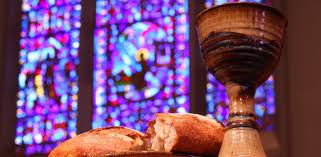
How often have we gathered around this table confident that we know exactly what is going on here around this table. Catholics and some Episcopalians are all so mysterious, always insisting on calling it “Holy Communion.” We like to call it simply “supper.”  Some believe that something mysterious takes place as they eat this meal. They call it transubstantiation. We only believe it is a dry little cracker and tiny sip of Welch’s grape juice and an act of remembrance that is confined to our limited and finite minds. 

But what if there is more going on here this morning than we can see, touch or taste or even remember? When we gather around the Lord’s Table, what if there is more going on here than meets the senses? What if there is some mysterious communion or a very holy fellowship happening here? Sharing what we merely call a “supper,” what if we are surprised to discover that we are somehow invited to join the same fellowship that is mysteriously and inexplicably enjoyed between the Father, Son and Holy Spirit? 

In and around this table, what if there is something afoot, something happening— moving, inviting, healing, strengthening, loving, forgiving, saving, calling, challenging, commissioning?

We have come to instruct and bless children, but we will leave having been instructed and blessed by them. We thought that we have come to remember a life, a death and a resurrection, but we will leave having been caught up in that life and death and transformed by that resurrection.

As Willimon has said, “For, that is our God at our God’s best. That night as Nicodemus talked with Jesus, he began with what he knew. And he ended with questions about what he did not know. He arrived fairly confident that he had a good grasp of, [a good hold on] who Jesus was; [he left surprised,] having been encountered and held by the mysterious, majestic Holy Spirit of God in the flesh.”[2]

This morning, when we awoke, we thought we knew what we were doing. We thought we were going to get up, get dressed and simply go to church, sing a few hymns, have the Lord’s Supper, listen to a sermon, dedicate some children. Then we would leave, get some lunch and come back home unmoved and unchanged, to watch a little more basketball.

However, when got here, we realized that we did not know it all. A song spoke to us, a small wafer and tiny cup filled us, a word challenged us, a child looked at us and blessed us, and God, the creator of all that is called us by name and loved us. Christ came and wrapped his arms around us as his Holy Spirit breathed new life into us. And now, we will leave this place changed, transformed and divinely commissioned to share the love of God with all people.

[1]Quote and interpretation of Nicodemus’ first words to Jesus “We know” came from William H. Willimon, We Know (PR 34/2; Inver Grove Heights Minnesota: Logos Productions, Inc., 2006), 49.

[2] Ibid.

Strength for the Journey

lent and communion

1 Kings 19 NRSV

Last week I spoke of being affirmed by God in the presence of God on one day; but then, it always happens, Monday morning comes, and we are hurled into a wilderness with trials and all sorts of temptation. For forty days, even Jesus found himself in such a place.

You might remember that I made the comparison to Elijah.  After being affirmed by God on Mt. Carmel, Elijah found himself in a wilderness that was so bad, he did not know if he wanted to live or die.

Listen to 1 Kings 19:3: “Then he was afraid; he got up and fled for his life.”  In verse three, it appears that he wants to live. He’s running from Jezebel to save his life. Now let’s look at the very next verse.  Verse four reads: “But he himself went a day’s journey into the wilderness, and came and sat down under a solitary broom tree.  He asked that he might die: ‘It is enough; now, O Lord, take away my life…”

His Monday morning was so bad, that one minute he wants to live, and the next minute, he wants to die.  Can you relate?

Elijah then fell asleep under that tree, but suddenly, an angel touched him and said to him, “Get up and eat.”  He looked and there at his head was a cake baked on hot stones and a jar of water.  He ate and drank, and lay down again.  But the Lord came a second time, touched him, and said, “Get up and eat, for the journey will be too much for you.”  “He got up and ate and drank, and went in the strength of that food for forty days and forty nights to Horeb, the mount of God.”

Today, some of you do not need to wait for Monday morning.  You are already there. One minute you want to live; the next minute, you are thinking that death might not be that bad of an option.  Others of you may be doing better than that today.  But as I said a few weeks ago, sooner or later, Monday morning is coming for all of us.

So I say to all: “Let’s get up and eat and drink from the table of the Lord.  For if you do not, this journey in the wilderness of life will be too much for you.”

Now, you might ask, how can one little, tiny, tasteless cracker, and one sip of juice give us sustenance for forty days and forty nights?

Do you remember my sermon on the transfiguration?  On the mount of transfiguration, before the disciples come back down into the wilderness of their lives, a voice came from heaven, saying:  “This is my Son, the Chosen, listen to him.”

This is my Son, the Beloved, the Chosen, the one who has been tested and tempted and tried in the wilderness of life, listen to Him.  Listen to the One who knows what it is like to be on the mountain top with God one minute only to be in Hell with the devil the next.  Listen to the one who knows something about the ecstasy of being affirmed by God in the presence of God one minute and to be famished in the middle desert the next minute.  Listen to the One who knows what it is like to be a human being living in a fallen world.  Listen to the one who spent most of his earthly life trying to survive in a vast and dark wilderness.

Listen to the Christ as he says…

“For God so loved the world that he gave his only Son, so that everyone who believes in him may not perish but may have eternal life. Indeed, God did not send the Son into the world to condemn the world, but in order that the world might be saved through him. ”

Listen to the Christ as he says…

“Your sins are forgiven.”

Listen to the Christ as he says…

“Your faith has saved you, go in peace.”

Listen to the Christ as he says…

“Daughter, your faith has healed you.  Go in peace.”

Listen to the Christ as he says…

“Whoever drinks the water that I give him will never thirst.  Indeed, the water I give him will become in him a spring of water welling up to eternal life.”

Listen to the Christ as he says…

“I am the bread of life.  He who comes to me will never go hungry, and he who believes in me will never be thirsty.”

Listen to the Christ as he says…

“I am the light of the world.  Whoever follows me will never walk in darkness, but will have the light of life.”

Listen to the Christ as he says…

“I am the good shepherd.  The good shepherd lays down his life for his sheep.  I am the good shepherd.  I know my sheep and my sheep know me.”

Listen to the Christ as he says…

“Your brother will rise again.”

Listen to the Christ as he says…

“I am the resurrection and the life.  He who believes in me will live, even though he dies; and whoever lives and believes in me will never die.”

Listen to the Christ as he says…

“Do not let your hearts be troubled.  Believe in God, believe also in me.  In my Father’s house are many dwelling places.  If it were not so, would I have told you that I go and prepare a place for you?  And if I go and prepare a place for you, I will come again, and I will take you to myself, so that where I am, you will be also.”

Listen to the Christ as he says…

“You are my friend”

Listen to the Christ as he says:

“I am with you always, even until the end of the age.”

Listen to Christ as he says, “This is my body broken for you.  This is my blood shed for you.”

Some might still say: “It is just a tiny, little cracker and a sip of juice.”  But I think you know that we can go in the strength of the food on this table, for forty days and forty nights, or however long our journey in the wilderness might last.

Carrying the Cross

Jesus_carries_the_cross

Philippians 3:17-4:1 NRSV

If there was anything good about seeing the movie, the Son of God , it was how it reminded us of the extreme heinousness of the cross. For two thousand years later, I believe many of us have forgotten the excruciating pain, the shame, and the horror of crucifixion on a cross. Our society has turned the cross into a hallowed symbol, a pretty piece of jewelry. We are no longer appalled at the nature of Christ’s death, and we no longer grasp the significance of what it means to share his sufferings and to imitate him in death as the Apostle Paul admonishes us to do.

So we live as what Paul calls “enemies” of this cross. We see our religion only in terms of benefit and advantage and are not prepared to share the humiliations and suffering that commitment to Christ  involves.

In thinking about the cross in relation to other world religions, the symbol for our faith is indeed a curious one. The cross is a symbol of suffering, shame and death. It is like having the electric chair as the symbol for our God. Think for a moment about other religions. Most have us have visited Chinese restaurants and have seen a statue of Buddah in the foyer. There he is, fat and happy: arms crossed; eyes closed; serene; peaceful; introspective; contemplative.  Compare that with the cross: cruel; painful; degrading, humiliating; lonely.  This is who our God is, and it is who we are called to imitate.  This is who we are called to be, and this is where we are called to go.

The good news is that you do not need to live long in this broken world to become grateful that our God is the God of the cross. For the world in which we live is not a serene, peaceful world where we have the luxury to cross our arms and close our eyes introspectively, contemplating it all. We live in a world where 15 year-olds take guns to school kill their classmates. We live in a world where the hearts of 44 year-old men stop beating as they sleep at night. We live in a world where malignant tumors grow inside of us and we are often unaware until it is too late. We live in a world where our automobiles crash crushing the life from us.  We live in a world where tornadoes and earthquakes and floods strike without warning.

Yes, thank God that our God is the God of the cross— A God who knows what it is like to suffer as we suffer;  A God who knows humiliation, who has experienced loneliness, who knows pain; A God who has entered our broken world to participate with us in our suffering.

In this season of Lent, may this be the God we imitate.

May we regard our religion as an opportunity to lose ourselves instead of an opportunity for advantage. May we through our church, with the help of our God, give of ourselves to others.  May we go to those places of suffering and shame of heartache and heartbreak and even death and participate in it. May we suffer with others, as God suffers with us.  May we imitate Christ and pick up and carry our cross.

Without God, All Things Are Possible

lent

Perhaps we have all heard the hopeful words of Jesus recorded by Matthew, “With God, all things are possible.”

However, isn’t the opposite also true? It was the great 19th century Russian philosopher Dostoevsky who penned the phrase: “Without God, all things are possible.”

Without God, things are apt to go awry.

Without God, we have the propensity to spin out of control.

As the Psalmist insists—without God all behavior that is foolish and destructive is not only possible, it has no limits (Psalm 73:7).

Without God, selfishness, greed, deceit, resentment, malice, racism, sexism, homophobia, hate and despair are not only possible, they are probable.

Walter Brueggaman has correctly observed that: “It is the knowledge of the reality of God present and at work in our world and in our lives which sets limits to destructive possibilities.”

Lent is a time to acknowledge that we need God in our lives, for without God, all sorts of sin and evil are possible. The good news of Lent is that God has come to be in our lives through Christ Jesus our Lord. And with God, there is much that is impossible.

With God, unforgiveness is impossible.

With God, loneliness is impossible.

With God, being lost is impossible.

With God, spiraling out of control is impossible.

With God, despair is impossible.

With God, death is impossible.

Lenten Contradiction

lent-wordcloud_2

“Ugh!!!  Ash Wednesday? Lent?  Really?  Do we really have to?  It all sounds too depressing and somber to me.  Acknowledgment of my mortality? Confession of my sin? Repentance, contrition, penitence?

“ I’m really not in to all that!  I really don’t like to hear about that kind of stuff. Suffering, mourning, fasting, ‘from dust you came and to dust you will return”—I can do without that in my life.  Besides it’s a contradiction of my faith! My faith is upbeat.  My faith is about life, not death.  My faith is about forgiveness, not sin.  My faith is about glory, not suffering.”

“And not only is it a contradiction of my faith, it is a contradiction of the world around me. The winter solstice is past. The days are getting longer. The sun shines a little brighter. Birds are beginning to sing again. I’m ready for some Spring! I’m ready for some new life!  I’m just not in the mood for the somber melancholy of Lent.”

“I tend to prefer some of these young preachers that  I have been watching on TV lately.  They tell me how to find power and success. They tell me how to feel good. That’s what I need. So you can have your Lenten services!”

The truth is that these forty days from Ash Wednesday to Easter are among the most counter-cultural and subversive in the church year. Confession of sin, repentance, penitence, contrition, the focus upon suffering, sacrifice and death, honesty about our own mortality—these are all matters that do not come naturally for us. We live in a success-worshiping, power seeking, feel-good culture. And Lent moves us an entirely different direction. It contradicts everything that our culture promotes.

Lent is primarily about the truth of our sin.  Sin that is so much a part of who we are that no matter how hard we try, there’s just no way to avoid it.  We can skip the Ash Wednesday service and the whole season of Lent and listen to those feel good preachers every day, but we cannot hide from the truth.

Yet, there is good news. And it is the greatest contradiction of all

As the Apostle Paul wrote to the church at Rome, though our sin was serious, in Christ, “grace abounded.” Our misdeeds are abundant, and our sin is boundless.  Yet, as Paul says:  in Christ mercy is abundant, and grace is boundless!

To the unrighteous has been given righteousness. We could not get good enough for God, so God in Christ made us good through revealing his saving love for us.  We could not do right by God, so God in Christ did right by us.

Instead of distancing God’s self from us for our failure to be good, loved us into relationship with God. This is the great, wonderful contradiction of the cross, the great contradiction of Lent upon which rests our hope in life and in death.

Lent: A Time to Tell the Truth

lenten_cross

A few years ago an Episcopal church in a coastal South Carolina town created a ruckus as when it placed three crosses on the lawn adjacent to their church. They draped them in purple for Lent. After a week or so, the church received a call from the local Chamber of Commerce.

They called complaining, “We hate to cause any trouble, but Spring Break is right the corner, and the tourist season is starting to crank up. And we think those crosses that you’ve erected are just sending the wrong message to visitors on the beach. People don’t want to come down here for a vacation and be confronted with unpleasantness.  On vacation, people want to be escape from all of the unpleasantries of life and relax, be comfortable.”

Well, after much debate, the church stood its ground, and the three crosses stayed.  “It’s Lent,” said the church. “People are supposed to be uncomfortable.”  William Willimon calls Lent “the season of unpleasant uncomfortability.”

Willimon says that one of the reasons this season we call Lent is so unpleasant is that it forces us “to confront so many of those truths about ourselves that we spend much of the rest of our lives avoiding.” Here, during this Lenten season, “we try to tell the truth about ourselves, and sometimes the truth hurts.”

Lent is a time to honestly say, “I am a rotten scoundrel. I do things that I ought not do. I know they are wrong, yet I do them anyway.  I don’t do things that I know I should do. I think way too better of myself than I ought. Even my best deeds are tainted with pride and selfishness.  Sin is so much a part of my life that I cannot escape it.”

Yes, this is the season of telling the truth, even if it pains us a bit.  But here’s the good news.  The truth will set us free! No matter how hideous, disgusting, and abominable our sins are, the God’s honest truth will always set us free, because in Jesus Christ, we have been loved, forgiven and accepted.

On Ash Wednesday, we will gather together to worship. During this special service we tell the truth, and then, we will hear the truth.  We could not do right by God, so God, in Christ, did right by us.

A Brief History of Ash Wednesday and Lent

ash-wed2

Early Christians observed Good Friday and Easter Day—separated by a fast—as a singular observance of the crucifixion and resurrection of Jesus.  However, this approach to the culminating events in the life of Jesus quickly changed.  By 100 A.D., Christian writings mentioned a period of fasting and praying called Lent.

 The season of Lent developed as people recognized the importance of Easter celebrations.  Christians developed a period of preparation to adequately ensure a proper observance of the resurrection event.  To truly prepare for Easter, Christians originally believed that a “tithe” or a tenth of the year should be given for such preparation. Forty days, which is roughly a tenth of the year, was chosen.  This is also the number of days Jesus spent fasting in the wilderness at the beginning of his ministry.

In most churches today, the Lenten season is the forty-day period between Ash Wednesday and Easter, excluding Sundays. Since the resurrection of Jesus, Christians have regarded every Sunday as “a little Easter.” Services were moved from the Sabbath to Sunday to celebrate the resurrection, thus, the Sundays between Ash Wednesday and Easter are referred to as Sundays in Lent rather than Sundays of Lent.

One of the most important ways to prepare for Easter during Lent is to recognize one’s sinfulness and need for God’s grace that is fully revealed in the crucifixion and resurrection of Christ. Throughout history, both Jews and Christians have used ashes to symbolize their sinfulness.  Wearing ashes is an Old Testament symbol of grief, penitence and mourning.

This Wednesday, First Christian Church joins Christians all over the world in this simple service. We gather to express sorrow for our sin and our mortality and to acknowledge the necessity to repent and accept Christ as our Lord and Savior.  Together, we recognize our need for the salvation made possible through the death and resurrection of Christ.  The service on Ash Wednesday has been very common among Catholics, Anglicans, Episcopalians and Lutherans.  However, since the 1990’s, the service has been adopted by mainline denominations including Methodists, Presbyterians, Disciples of Christ, and moderate Baptist churches.

Mainline churches believe there is an increased relevance for this service in light of the contemporary church movement to exclude signs of the faith that people may find offensive.  In an age where many churches have removed crosses from their sanctuaries and potentially offensive language such as “repentance,” “lost,” “sin,” “blood” and “death,” First Christian Church proudly and humbly embraces these basic tenets of our faith.