Steady Until Sunset: Remembering Larry Gene Vaughn

Larry Vaughn

In the 17thchapter of the Book of Exodus we read the amazing story of how the Israelites defeated of their enemy, the Amaleks. The Amaleks were a group of nomads who attacked the Hebrews in the desert of Mount Sinai during the Exodus from Egyptian slavery. The Amaleks swooped in on the Israelites and cowardly killed those who were lagging behind.

For that is what the enemies of life do. For some the enemy is cancer. For some it is diabetes, renal failure and heart disease.

And when the enemies of this life attack us, we are faced with a choice. We can surrender to our enemies; we can succumb to their attacks; we can bemoan or whine, or we can stand our ground and fight.

Moses said to Joshua, ‘Choose some men for us and go out; and fight with Amalek.’

This week, I have heard more than one person say that they had no idea Larry had the health issues that he had or that Larry must have had more health problems than he let on.

Because Larry was always so positive. Always upbeat, steady. Although he spent five hours a day, three days a week in a dialysis unit, he never complained.

He knew he had an amazing life. He was grateful to have had the opportunity to spend time in over 40 countries through the Oil and Gas industry, to learn different customs and to appreciate different traditions. I love listening to his stories, especially the way he would describe the beauty of wildlife in different parts of the world and the food he enjoyed while traveling. Always remaining true to his positive spirit, every steak he ate was the best piece of beef, and every deer he saw was a monster.

Many men in Larry’s health surrender and succumb to such illnesses. They lose strength within to fight, to continue living, to continue working. They can reach down and dig deep; however, there is just nothing left. No amount of digging will see them through.

However, men with faith in the God of Abraham and Isaac, Moses and Joshua, men with faith in the God, understand that true strength does not come from within, but comes from and by the grace of God.

Moses said to Joshua:

Choose an army and fight. I, myself, retired a long time ago from fighting. I am too old, too tired, but I will stand on the top of a hill and raise the staff of God with my hands and summon the grace and strength of God to defeat our enemy.

So Joshua did as Moses told him, and fought with Amalek, while Moses, Aaron, and Hur went up to the top of a hill. 

Whenever Moses held up his hand, Moses noticed that Israel prevailed; and whenever he lowered his hand, he noticed that Amalek prevailed. [This was a certain sign that it was God, and God alone, who was giving the Israelites the grace, perseverance and strength to defeat their enemy].

I don’t believe can be no other explanation for the optimism and positive spirit of Larry Vaughn considering his poor health. It was more than some inborn competitive sprit or personal determination, drive or grit. It was something divine.

Larry simply never quit. He kept persevering. He kept fighting. He wanted to do whatever he could to keep to keep living, to keep working, to keep hunting, to keep being there for his family and friends. “Oh, to do that, I need to have a triple bypass and possibly a valve replacement to be on the kidney donor list. Ok, sign me up!”

Many studies have been made to identify symptoms of depression or the giving up on life. People who give up and surrender to the enemies of life become detached and disengaged from the world around them. They no longer care what their neighbors are up to. They begin to ignore their children and their grandchildren. They stop communicating with their spouse, and most certainly with their ex-spouse. They become disinterested in their church.  And they stop paying attention to the news and to sports.

Although dialysis took a toll on Larry, he possessed any of these symptoms. Larry enjoyed his evenings with Elizabeth, watching the news, the wheel of fortune and a movie. He was forever selflessly doing things for his Jason and Jordon, always finding time to do things with and for Grayson. Through thick and thin, he never missed a day without checking in with them. Just as he did throughout his life, no matter where he was.

He was not only interested in his church, attending every Sunday, but he was even interested in his pastor. He kept up with my work with persons with special needs through Ainsley’s Angels on facebook. He became especially concerned about me when he discovered that I had not been hunting since 1993. So concerned, that he scheduled us a dove hunting adventure for the first of September.

He cared about what was going on in the world, and he was in no way, shape or form disengaged from sports. He continued to follow his alma mater Arkansas Tech in sports and loved watching Razorback game.

It was obvious to everyone that knew Larry, that he never gave up. For as Isaiah 40:29 reads, Larry was a living testimony that “God gives strength to the weary, and to him who lacks might God increases power.” And in the 73rdPsalm we read: “My flesh and my heart may fail, but God is the strength of my heart and my portion forever.” Larry Vaughn was a living example to all of this great truth.

That’s why so many of us were left scratching our heads when we learned of his passing. We simply had no idea that he was so sick.

Our story continues in Exodus:

But Moses’ hands grew weary; so Aaron and Hur took a stone and put it under him, and he sat on it. And Aaron and Hur held up the hands of Moses, Aaron on one side and Hur on the other, and the hands of Moses were steady until the sun set.

God has always used others to do God’s work in this world. God calls each of us to minister to one another. God uses us to supply God’s strength to those who are weak, to keep them steady, to help them fight the good fight, to finish the race. Such was the case in this victory of Amalek. Moses did not possess the strength to keep his hands raised through the duration of the battle, so God sent him Aaron and Hur who brought him a rock to sit upon and then held up each of his hands.

God also sent Larry others to give him support when he was the most weary.

Last week, when Larry needed support, God sent him good friends, Dr. Dana Rabideau and Wayne Wright who who traveled great distances to be with him. They were so faithful to him. And of course, his twin brother Jerry, who had been a part of Larry his entire life, was there with Susie letting Larry know that he was loved. As was his companion Elizabeth. Divorced, but still together, until death parted them.

Larry and Jerry love to tell stories about them fighting and whipping one another. Jerry talks about beating him up during the day and Larry sucker punching him while he slept at night. Jerry talks about one incidence when Larry stabed him in the leg with a knife during a competitive game of Mumble Peg. Jordon remembers the two of them wrestling, trying to get the best of each other, in the White River. But more often than they were horsing around and competing with one another, they were supporting one another. They were loving one another. And in the end, Jerry, you were there for him.

You could say that you brought your brother Larry a rock to St. John’s Hospital in Tulsa to steady his hands until the sun set. And together with Elizabeth, Dana and Wayne, you were to Larry like Aaron and Hur were to Moses.

And the hands of Moses were steady until the sun set. And Joshua defeated Amalek and his army.

And the good news for us today is, that this same God, the God of Abraham and Isaac, the God of Moses and Joshua, the God revealed in the Risen Christ and in the life of Larry Vaughn, will give us strength in our grief, joy in our suffering and grace in our lives. God will send others: friends and family and church members to hold our hands, to keep them steady, until the sun sets, until the battle is won.

But the really good news is that the final battle, the battle with life’s final enemy has already been won. As Paul wrote to the Corinthians: “Death has been swallowed up in victory. O death, where is your victory? Where is your sting?”

The good news for all of us today is that as God has stood by Larry and gave him strength to battle the enemies of life, through our resurrected Lord, God has defeated death, and Larry is now and forever with his Lord.

May this good news help us now to live our lives as Larry lived his: Persevering with the strength of God, receiving help from friends and family who provide us a rock, living with the steady purpose of sharing the joy and the hope of the Lord with all people, until the sun sets here and rises forever in eternity. Amen.
For Easter to Happen, Somebody Needed to Pick Up and Carry a Cross

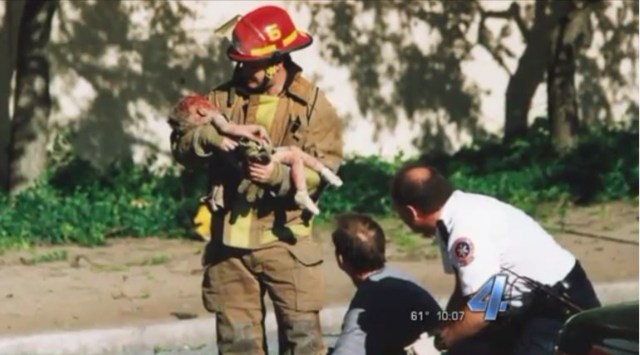
oklahoma city bombing firefighter baby

Luke 24:1-12 NRSV

It is Easter Sunday! Resurrection morning has dawned. New life is being born! Something wonderful has been lost, but something magnificent is being gained.

However, on this Sunday of Sundays, I believe it is important for us to realize that before we can experience new life, before we can celebrate resurrection, before we can sing alleluias, before love can win, somebody needed to pick up and carry a cross.

And the sad thing is that there are very few of Jesus’ disciples who understand this. They do not understand it today, and they did not understand it 2,000 years ago.

Although Jesus continually taught that to gain our lives, we must be willing to lose our lives, that Easter could not happen without some self-denial, that resurrection could not come without some self-expenditure, that new life could not be born without some sacrifice, that love could not be won without some suffering, that the the light of Sunday morning could not  dawn without the darkness of Good Friday, when the time came for the disciples to follow Jesus all the way to the foot of the cross, most all of them very selfishly fled to save their lives.

One would betray Jesus. Another would deny that he even knew Jesus. Nearly all would desert him. In spite of Jesus’ continual call to pick up a cross and follow him, most of the disciples never got it.

However, there were a few disciples who did get it. There were a few who were willing to carry a cross. There were a few who chose to live selflessly and to love sacrificially. There were a few who faithfully followed Jesus all the way to Golgotha.

Although the intrinsic sexism of this world’s history has caused many in the church to overlook these faithful disciples, the good news is that all four Gospel writers did not.

In Luke 8 we read these words: Afterward [Jesus] journeyed from one town and village to another, preaching and proclaiming the good news of the kingdom of God. Accompanying him were the Twelve and some women…Mary, called Magdalene… Joanna…Susanna, and many others…” These women helped support Jesus and the twelve “out of their own means.”

And on Good Friday, when none of the male disciples could be found, Mark 15 reads: “There were also some women looking on…among whom were Mary Magdalene, and Mary the mother of James, Joses, and Salome.

In Matthew 27 we read: “Among them [gathered at the foot of the cross] was Mary Magdalene, and Mary the mother of James and Joseph, and the mother of the sons of Zebedee.

In John 19:25 we read where all the male disciples fled: “But standing by the cross of Jesus were His mother, and His mother’s sister, Mary the wife of Clopas, and Mary Magdalene.

There are many problems with Christianity today. However, I believe one of the biggest problems with our faith today, especially here in North America, is that we have too few Mary Magdalenes.

There are too few people who understand that authentic faith, true discipleship, always involves a cross. It always involves answering a call, taking a risk, denying oneself, going against the status quo, pushing the boundaries, stepping way outside one’s comfort zone.

A problem with the church today is there are too many Christians who believe they can sing “alleluias” on Easter Sunday without going through some suffering on Good Friday, who believe they can experience some new life without death to self, who believe they can somehow rise up from the waters of baptism without getting their hair wet, who believe they can serve Jesus without getting their hands dirty.

What this world desperately needs needs right now, and what the church needs more than anything today, are more disciples like Mary Magdalene. For Mary Magdalene understood that when Jesus called people to be his disciples, Jesus was always clear that there would be a cross involved.

I think this is the reason that Mary Magdalene is remembered today by Matthew, Mark, Luke and John. This is the reason she is mentioned by name by the gospel writers more than any other apostle. And this is the reason that today, on this Easter Sunday morning, Christians all over the world will hear her name mentioned as they gather to worship.

Some will hear her name as Mark 15 is read: “Mary Magdalene and Mary the mother of Joses were looking on to see where Jesus was laid.”

Some will hear her name as Matthew 28 is read: “Now after the Sabbath, as it began to dawn toward the first day of the week, Mary Magdalene and the other Mary came to look at the grave.”

Some will hear it as Mark 16 is read: “When the Sabbath was over, Mary Magdalene, and Mary the mother of James, and Salome, bought spices, so that they might come and anoint Him.”

And others will hear it as John 20 is read: “Now on the first day of the week Mary Magdalene came early to the tomb, while it was still dark, and saw the stone already taken away from the tomb.”

Just as Mary Magdalene had given what she had to support Jesus’ life, Mary was still doing all she could for Jesus in death.

And because she always selflessly pouring herself out, because she kept giving, kept sacrificing, kept risking, serving, bending, expending, anointing, because she was the most faithful of all of the disciples, because she not only sacrificially followed Jesus all the way to the cross, but courageously followed him all the way to the grave, because she followed him to the very end, she was the first person on earth to see the risen Lord.

Mark 16:9 reads: “Now after He had risen early on the first day of the week, He first appeared to Mary Magdalene…”

And in John 20:18 we read where it was Mary Magdalene who first proclaimed the good news of Easter, speaking five simple words that changed the world forever: “Mary Magdalene came, announcing to the disciples, ‘I have seen the Lord.’”  Not only was she the first person to see the Lord, she was the first person to proclaim the world-changing, earth-shaking, life-saving good news of Easter to the world!

Mary Magdalene was the very first to preach the glorious good news of resurrection on Easter Sunday, because she stayed with Jesus until the very last in his suffering and death of Good Friday. Easter happened for Mary because she had answered a call to follow Jesus, and she followed Jesus all the way.

Observing Good Friday this year was a surreal experience for many Americans, as it fell on April 19, the day of the terrorist bombing in Oklahoma City.

The story of one survivor, Terri Talley, exemplifies the suffering experienced by our nation, as well as how new life was raised out of the ashes through those who were willing to pick up and carry a cross.

Employed by the Federal Employee’s Credit Union on the third floor of the Murrah Federal Building, that morning was extremely busy for Terri. She had just returned to work after spending several days away, and a stack of paperwork waited for her.

Catching up on work, Terri took a moment that morning to chat with her good friend and coworker Sonja Sanders. “For her, it was a big day. She had just been promoted into management,” states Terri, who is certain she was the last person to have spoken with her friend.

What seemed like just moments afterward, everything changed. At 9:02 am, thousands of pounds of explosives, assembled in the back of a Ryder moving truck parked in front of her office building, exploded.

Terri recounts: “I fell from the third floor to somewhere around the basement level. It was really really fast. It was so fast that I didn’t really know what had happened. The suction pulled me down so quickly.”

Surrounded by noise Terri says, “When I came to the first time, I thought: ‘This is a really bad dream. I will just go to sleep and when I wake up everything will be okay.’ But when I came to [again], everything wasn’t okay. I thought that I must have been in a really bad wreck, and I must be [pinned in the wreckage], because I couldn’t see anything. I couldn’t move. I couldn’t even scream for help. I would try, but I was really squished. And I thought to myself: ‘I hope someone finds me.’”

Terri was found by a firefighter who almost overlooked her. [Like being sealed in a tomb] she was completely encased in concrete and granite. Terri says: “There was just a little hole and a little piece of me was showing. He touched me and … started screaming: ‘Hey! I have a live one here, and I need some help!'”

After much hard work, Terri was freed and rushed to a nearby hospital, where her injuries were identified: temporary blindness, a concussion, temporary amnesia, a cracked first vertebra in her neck, a broken right ankle, skin damage on her foot, and multiple abrasions. During her seven days in the hospital, and for weeks following, a sense of shock permeated her life.

However, today, she has this powerful message for the world:

I always tell [even] the littlest of kids: ‘Don’t think that there is nothing you can do, because kids would color pictures and send me notes. Those made me feel like people were really thinking about me. You can always do something, no matter what age you are.’[i]

This illustrates that to experience Easter Sunday, we have to have a Good Friday.

Before new life could be experienced, before resurrection could be celebrated, before “alleluias” could be sung, before love could be won, somebody needed to pick up and carry a cross.

-First Responders needed to run toward an explosion.
-Firefighters needed to go into a burning building.
-Doctors and nurses needed to give all that they had to give.
-Friends and family and church members needed to pray.
-And little children needed to pick up some crayons and color a picture.

To make Easter happen for someone–today, right here, right now–we can all do something, be something, risk something, sacrifice something, give something, create something.

We can all pick up and carry a cross.

We can feed someone who is hungry.

Visit someone who is lonely.

Love someone who is hurting.

Include someone who has been left out.

We can mentor someone who lives in a foster home.

Care for someone who is sick.

Forgive someone who has made mistakes.

Believe someone who has been abused.

We can share grace with someone who faces discrimination.

Stand up for someone victimized by injustice.

Speak out for someone devalued by oppression.

We can stay close by and anoint someone who is dying.

Be a friend to someone who is grieving.

With the spirit of Mary Magdalene, let’s keep the faith, and let’s keep the faith going, keep it moving forward, all the way to the foot of the cross, through the betrayals, through the fear, through the denials, through the suffering, through the shame, all the way to the grave, even to a tomb that has been sealed by granite or concrete.

Let us keep doing whatever we can, with whatever we have, wherever we are, to love one another until the entire world is able to sing:

“Alleluia! Alleluia! I have seen the Lord!”


[i]https://www.nps.gov/okci/learn/historyculture/stories.htm

Remembering Harold Stewart

harold stewart pic
July 17, 1946 – January 1, 2019

As evidenced by the attendance here this morning, the shocking news of Harold’s passing has been devastating to many.

We did receive some comforting words. Harold did not suffer. There was no prolonged illness, no pain, no struggle. Harold was given the opportunity to celebrate Christmas with loved ones here in Fort Smith and then in Nebraska. Harold was happy. He was full and content.

But then we received a dreadful word, a word that was difficult for us to hear, that that his wife Audrey, whom we all know he adored, had to drive home from Nebraska all by herself as Harold’s body was sent home by another way.

“Home by another way.” Those are the exact words Matthew uses in yesterday’s gospel lesson to describe the journey of the Wise Men after they worshiped Jesus, laying down their gifts of gold, frankincense and myrrh. Having been warned in a dream not to return to King Herod, we are told that they went “home by another way.”

“Going home” is of course how we like to talk about death. We find great comfort in the old hymn:

O God, our help in ages past, our hope for years to come, our shelter from the stormy blast, and our eternal home.

“Home” is being with God. It is a place of perpetual belonging, acceptance, comfort and love. It is a place of eternal rest and peace.

In his book of Revelation, John described it this way:

“And I heard a loud voice from the throne saying,

See, the home of God is among mortals.

God will dwell with them;

they will be God’s peoples,

and God himself will be with them;

God will wipe every tear from their eyes.

Death will be no more;

mourning and crying and pain will be no more,

for the first things have passed away (Revelation 21).

So, in a way, going home is the goal of every believer. And as Christians, we believe that how we get there, how we go home, matters.

Do we go home following the instructions of King Herod? Do we go home by collaborating with the empire? Or do we go home by another way?

Do we go home following the way of greed and power, the way of self-centeredness and fear, the way of deceit and cowardice, the way of exclusion and isolation? Or do we go home by another way?

I believe the most comforting word, the most hopeful word for us this morning was what we first thought was a most dreadful word: “Harold went home by another way.”

As Christians, we believe Jesus showed us the way, the truth and the life, the very narrow, yet broad and expansive way home.

Matthew writes:

One day Jesus was teaching a large crowd of people. While he was still speaking, his mother and his brothers were standing outside, wanting to speak to him. Someone said to him, ‘Look, your mother and your brothers are standing outside, wanting to speak to you.’

But Jesus replied, ‘Who is my mother, and who are my brothers?’ And pointing to his disciples, he said, ‘Here are my mothers and my brothers!’ (Matthew 12:46-50).

In other words Jesus said, “here is my home, here is my family.”

I believe this story reveals that Jesus had a much broader, more expansive definition of home and family than we often do.

This, of course is why Gentile Wise Ones from the East were guided by that star to worship the Jewish Christ child: The people of God, the family of God, extends beyond Israel, and includes all people.

And so it was with Harold.

If I said to you, “Harold sure did love cooking for his family.” Your first response would probably be: “Which family are you talking about?”

Are you talking about the Stewart family? Or are you talking about his family at the Elks Lodge? Perhaps you are you talking about his family at First Christian Church?

Someone told me that he left Mike and Jane one of his famous pizzas in the fridge before he and Audrey left for Nebraska. That was so Harold. As his mother Roberta Ray used to always say: “It is very difficult to get Harold out of the kitchen!”

Harold also loved to make his pizza monthly for his Elks lodge family. And each time Harold invited me to the lodge and introduced me to other lodge members, it was obvious to me that he was introducing me to his home away from home. During the fish fry, he introduced me to his son Mike and daughter-in-law Jane, but he also introduced me to countless sisters and brothers. Chris Perry has written that Harold’s example and leadership is the reason they like to say that the “Elks Loge 341 is the friendliest little Elks Lodge in America.” That is because they are truly a family.

And of course this church was the beneficiary of having a brother named Harold in our family. Our brother Harold spoiled us with that infamous pizza recipe, the juiciest hamburgers you have ever tasted, unbelievable pulled-pork barbeque, and most recently, a Christmas dinner that featured a prime rib that Steve Riggs described best as “crazy good.”

What if I said to you that “Harold loved being there for his family?”

Well, are you talking about his sons Brian and Mike? Are you talking about one of his six grandchildren or his great-grandson?

Are you talking about his family at Fort Smith Restaurant Supply? Are you talking about the names of the people with whom he worked that he would text to his pastor requesting prayer for them when they were sick, experienced a loss or had a need?

Or are you talking about a child he mentored for the last three years at Howard Elementary School? Are you talking about the 12-year-old boy he visited once a week, oftentimes bringing him lunch, building his self-esteem, encouraging him in his studies and teaching him the importance of values that he may not learn in the classroom, like looking someone in the eyes while giving them a firm handshake?

Or are you talking about one of the children at the church who he made an effort to greet every Sunday morning before reaching in his pocket and giving them a piece of candy.

Yes, the good news is that Harold certainly went home by another way.

Speaking of going home by another way, it is no secret that Harold could literally build a home. His sons describe him as the best teacher they ever had. They even built an entire house together on Ten Killer Lake. Harold taught them how to do everything, from carpentry, duct work, heat and air, plumbing to laying tile and flooring. They said Harold knew how to crack a whip in such away that you never even knew there was a whip.

Harold could fix anything. His son Brian recalls that anytime he or Mike ever had a problem with their house, whether it be carpentry, plumbing, heating or air, all they had to do was call Dad. They said: “And it seemed like it was before we get the phone hung up the doorbell would ring and there would be Dad, standing there wearing a tool-belt around his waist and light on his head.”

With Harold, anytime something would break, his family said they never called a professional. They called Harold. Just like we did here at the church. Just like I am sure they did at the Elks Lodge.

Yes, more than anyone we know, Harold went home by another way.

Yesterday, someone asked Audrey: “How in the world did you drive home all by yourself?” She replied: “I had a good teacher.”

We all know how he absolutely adored and cherished his wife of 38 years, Audrey, but the love he expressed to Audrey always seemed to have an even higher purpose. For me it was like he was modeling for others what love looks like, what being a true gentleman looks like, what being an authentic disciple of Christ looks like.

As I watched him each Sunday morning, walking into the church building holding Audrey’s hand, opening the car door for her after church—it was as if he loved her as an example to the world how we ought to love one another.

Perhaps that is exactly what Harold was doing. Harold was not only a mentor to a young man at the Howard Elementary. He was trying to teach us all how to be wise men and wise women and go home by another way.

He was teaching us how share the inclusive, expansive love of God with all people; how to see and treat all people as children of God, as sisters and brothers; how to leave this world a better place than we found it.

Yes, as his sons have said, Harold was one of the best teachers we have ever had, for he taught us all how to be wise men and wise women by avoiding the way of King Herod that so many seem to be taking these days, and instead, choose another way:

the way of chivalry over the way of indecency,

the way of love over the way of indifference,

the way of compassion over the way of apathy,

the way of sacrifice over the way of self-centeredness,

the way of inclusion over the way of fear,

and the way of calmness and peace over the way of stress and worry.

And when we choose to go home by this way, not only will we change the world and leave this world a better place than we found it, we can rest assured that like Harold, we will see that the home of God is among mortals. With Harold, we will dwell with God and be God’s peoples. God God’s self will be with us.

To wipe every tear from our eyes.

Death will be no more;

mourning and crying and pain will be no more,

for the first things have passed away.’

There is a great old hymn with beautiful words that describes what Harold experienced the first day of this new year.

Just think of what it must be like to step on shore and finding it heaven,

Of taking hold of a hand and finding it God’s hand.

Of breathing a new air and finding it celestial air,

Of feeling invigorated and finding it immortality

Of passing from storm and tempest into an unbroken calm,

Of looking up and finding it home.

A Glimpse of Heaven: Remembering Janice Rickman

Janice Rickmans Tie Dye Moment
May 24, 1946 – Dec. 8, 2018

One of my favorite authors and preachers, Frederick Buechner, has wondered what Heaven is like. With me, he believes we can get a foretaste of heaven right here on earth.  Buechner writes: “To speak of ‘heavenly’ music or a ‘heavenly’ day isn’t always to gush but sometimes to catch a glimpse of something.”

Upon experiencing something that is soooo good, perhaps we have all said, “Ahhhh! This is heaven!”  A bite of chocolate cake. A warm cookie with cold milk.  A lover’s touch.  A faithful friend.  A child’s hug.  A walk on a beach or in the snow. Resting one’s head on your mother’s shoulders. Undeserved forgiveness.  Unconditional love.  Unwavering devotion. Unexplained strength.

I heard a another preacher describe it this way: Heaven is sort of like this perfect room on the second floor of the house. It is a room upstairs where we are not yet permitted to enter from our position in a room here on the first floor.

However, there is this small, tiny hole in the ceiling of our room. And if we position ourselves just so under that hole.  At just the right angle.  At just the right moment.  If the light is just so. The shadows fade and we can see a little of that room. We can catch a glimpse of Heaven.

Greta will tell you that one thing that she will never forget is her mother recalling the moments after Greta was born, and specifically that moment Janice held her for the first time. As soon as the doctor handed Greta to her, as she held Greta in her arms, pressed her lips to kiss Greta’s forehead, and said Greta was “as warm as toast.”

Greta, you will always remember that, because your mother was describing a moment for her that was nothing less than heavenly. As she held you in her arms, as she loved you as she loved Bradley and Sarah, with a love that was out of this world, that hole in the ceiling got a lot larger for your mother. The light got just right, the shadows faded and heaven came down.

The Bible paints many portraits of the widening of this hole in the ceiling.

The prophet Isaiah prays for such widening:

Shower, O heavens, from above,

and let the skies rain down righteousness;

let the earth open, that salvation may spring up,

and let it cause righteousness to sprout up also;

I the Lord have created it. (Isa 45).

Ezekiel writes about the glimpses of heaven he experienced:

In the thirtieth year, in the fourth month, on the fifth day of the month, as I was among the exiles by the river Chebar, the heavens were opened, and I saw visions of God. (Ezekiel 1).

Malachi talks about opening a window to heaven,

…see if I will not open the windows of heaven for you and pour down for you an overflowing blessing (Malachi 3).

John talks about opening a door to heaven:

After this I looked, and there in heaven a door stood open! And the first voice, which I had heard speaking to me like a trumpet, said, ‘Come up here, and I will show you what must take place after this’ (Revelation 4).

And then we have those beautiful recollections of Jesus’ baptism as the Gospel Writers describe the heavens opening up. Mark literally says the heavens were “ripped apart” as the Spirit of God descended like a dove.

Greta and Sarah, I do not believe either one of you will ever forget the many ways that your mother helped to open up the heavens for you, to make that tiny hole in the ceiling a little wider, to move you to just the right position, to be in just the right light, at just the right angle, for the many times she caused heaven to only open but to actually come down so close to earth that you could feel it, hear it, smell it, and touch it.

When we study the Bible, from the enslavement of the Israelites in Egypt, through the occupation of Israel by Babylon, to the oppression of Christians by the Roman Empire—from the tribulations of Job, the persecution of Daniel, through the arrest and crucifixion of Jesus, to the trials and hardships of the Apostles Paul and John, the one theme that is constant is the divine strength, the holy resoluteness, the sacred presence of God in difficult times.

Greta and Sarah, you and Bradley, all of her grandchildren have witnessed this miraculous strength in ways that you are still trying to, but may never comprehend. Whatever storm came her way, divorce, death and disease, her love for you never failed, in fact, it never even wavered. Her love for you was indeed out of this world. No matter her circumstance she was always there with you, never away from you, always for you, never against you.

She possessed this supernatural strength, this holy fire, this divine determination to always be there to give any of you what you needed. Janice became a single-parent when Bradley was 11, Sarah was 9 and Greta was 2, and although she experienced the grief and sorrow of divorce, she never let you kids see it. She remained dedicated to her job as a legal Clerk and later with ABF to make sure that your needs were always met. If she ever went into her room, closed the door and cried, you never knew it. Her love was selfless. Her love was sacrificial. It was self-expending. It was heavenly. And there is no wonder that you look back on your childhood today, at her love and care and strength, and ponder, “How in the world did she do that?” In her strength, you were catching a glimpse of heaven.

During this Advent season, we celebrate another moment when the heavens were opened, when a choir of angels filled the skies to announce the birth of a baby.

John describes the announcement this way,

See what love the Father has given to us, that we should be called children of God; and that is what we are (1 John 3:1).

Through the gift of a baby born in Bethlehem, we are all born into the family of God. Through this baby named Jesus, we have been made family.

For 20 years, Janice worked as a legal clerk here in Fort Smith. When she left that position to work for ABF, she grieved. Why? Because her co-workers there in the legal office had become family to her. The same thing happened while she was at ABF.

Janice was not a member of the church or the denomination with which I serve as pastor. She was a proud member of the Church of Christ.

When she first moved to Methodist Village, one of her big concerns was that they were going to make her a Methodist. To illustrate this, the first weekend she moved into Methodist Village this past April, they had a tornado warning. The protocol for a tornado warning is to place identification tags on a lanyard around the necks of all the residents. When they placed a name tag around Janice’s neck, she wasn’t so much concerned about the possible tornadoes as she was about her name being printed under the word “Methodist.” She took one look at her badge and said, “I knew it. They have made me Methodist!”

So when I would visit her at Methodist Village and others would ask her if I was her pastor, she would immediately respond: “Oh no. He is my daughter’s pastor.”

This makes it all the more special some of the last words she spoke to me. She looked up at me said, “I love you.” Janice loved me, not as her pastor, but as family.

With those three simple words, “I love you”, she moved me. She moved to just the right spot, to that spot where the light was just right, to that spot where the shadows faded, and just for a moment, I could see through that hole in the ceiling, and I caught a glimpse of heaven.

This is the power of love. Love has the power to make strangers family. Although we have different faiths and different beliefs, love has the power to unite us all as sisters and brothers.  And when we love one another like family, when we treat one another as sisters and brothers, the heavens are ripped apart!

Since I have been a pastor here in Fort Smith, I have been impressed with the quality of care and love I have witnessed through the good people who work and serve at Methodist Village. They truly love and care for the residents as family. So each time I go out there, every time I visit, I catch a glimpse of heaven.

As I’ve mentioned, when Janice first became a resident of Methodist Village, it took her a little while to accept it. At first, it was a strange place, a place where she did not belong. After all, as she would tell me, there were “old people” living there. She assumed that her stay there would only be temporary. She would get a little rehab and then go home.

So, who could blame her for not immediately embracing nursing home residency and all of the activities and programs they offered. When she first arrived, if you wanted to visit Janice, you knew that you could always find Janice in her room. She wouldn’t be in dining hall with the other residents tossing a bean bag or playing bingo.

One day, when Sarah came to visit, like always she went straight to her room, but Janice was not there. She walked down to the nurses’ station where they would sometimes seat her, but Janice was not there. She searched the entire facility until she finally asked someone for assistance.

They said, “Well, today is Tie Dye Day! Perhaps she is with the other residents making a Tie Dye!”

Sarah immediately responded, “Oh, I don’t think so.” But they went down to the dining room anyway where everyone was tie dyeing, and there she was.

She was sitting there wearing this tie dye wrap, or scarf, or hat that she had made on her head. And she was holding this clapper in one hand, this hand that made a clapping noise when you moved it back and forth.

She looked up at Sarah. And waving the clapper in one hand and holding up a peace sign with the other, giggled and said, “I am having a tie-dye moment! And I am ready to party.”

Sarah responded the way that most of us respond these days when we catch a glimpse of something like this, something beautiful, something fun, something that warms our heart and makes us smile, something that is soooo good that we can only describe it as heavenly.  She pulled out her phone and took a picture and sent it to Greta.

And the good news is that this picture of Janice having a tie-dye moment, is a picture of Janice today. Through the tiny hole in the ceiling, we can see her today, sitting in the banquet hall of heaven, surrounded by family including her son Bradley, enveloped by eternal love, encircled by amazing grace, giggling, clapping, partying.

And because of that, we who grieve today know we are going to be ok. Greta and Sarah are going to be fine. Her grandchildren are going to be fine. Not only because your mother and grandmother has given you some of her strength and love (after all, you said you only needed a piece of it to be ok), but because you will be able to always see her, she will always be with you, each time something moves you to just the right spot, at just the right angle, when the light is just right, and the shadows fade, and this warmth comes over you, as warm as toast.


Remembering Naomi Hatley: Things Are Not What They Appear to Be

Naomi Pic
Naomi Hatley
April 17, 1924 – November 16, 2018

Esther 9:20-23

John 16:20-24

The late Reverend Warren Carr, a friend of mine and mentor, once said that a person’s eulogy in a Christian memorial service should be limited to those aspects of a person’s life that proclaimed the gospel, proclaimed the message Jesus proclaimed.

The good news is that we have much to say about Naomi today for she proclaimed the message of Jesus in ways that Rob and I never could.

When many think about proclaiming Jesus, they might first think about preachers. However, as those words attributed to St. Francis, “Preach the gospel at all times. If necessary, use words,” teach us, you don’t have to be preachy to preach.

Naomi was anything but preachy. Her faith was quietly practiced but deeply felt. Always self-effacing, she never imposed her faith on others.

However, her faithfulness was clearly evident to all. Many witnessed her faith through her active participation with this church as she led worship by singing in the choir and playing bells with the Primetime Ringers. She was an active member of the Christian Women’s Fellowship and possessed the heart of a servant, always enjoying potluck dinners and other fellowship occasions. When she could no longer drive to church, she had the church van pick her up at Butterfield Place so she could be here to faithfully worship and serve with her family of faith.

However, this was certainly not the only way that Naomi proclaimed the gospel.

It could be said that Jesus spent much of his ministry trying to teach us that things are not always as they appear to be. Sometimes reality is the exact reversal of actual appearances.

For example, Jesus said that those who appear to be last are actually first. And those who seem to be first are actually last.

In his first sermon, he said that it is not the rich who are blessed, it is the poor. It is the not the strong who inherit the earth, it is the meek. The Apostle Paul said it is not the wise who shame the foolish, but it is the foolish who shame the wise. It is the weak who shame the strong.

The gospel continually teaches us that things are not what they appear to be.

Of course, Naomi, first taught us this reality with her name.

It is not Nayomey or Nyomi.

It is Nayoma.

No matter how it is spelled, or what you’ve heard, or what you’ve read, no matter what you’ve seen or think you see and hear right now, things are not what they appear to be.

Naomi taught us this gospel truth in many other ways. Perhaps the the ways we will most remember, and for which we are most grateful, are the ways Naomi taught us, in the words of Ralph Sockman, that “nothing is so strong as gentleness, and nothing is so gentle as real strength.”

If you thought Naomi was gentle and quiet, then you probably never watched a Dallas Cowboy or Arkansas Razorback football game with her.

If you thought Naomi was a non-athletic spectator, someone who sat serenely on the sidelines of life, you probably never saw her slalom waterski, which she did until the age of 69 when she fell and cracked three ribs.

If you thought Naomi was this prim and proper Southern Belle, you probably never saw her play in the waves of the ocean. You never heard her laugh like a child as the waves would crash over her head knocking her off her feet.

If you thought Naomi only enjoyed soft church music, the chimes of handbells, the harmonious sound of a choir, a piano and organ reverently praising God, then you’ve probably never been to an Eric Clapton concert with her.

If you thought her husband of 66 years Pete, with his large, confident personality was the rock of the family. Then you probably didn’t know Naomi as well as her children knew her, as one with an iron backbone in a fluffy coating.

If you thought Naomi might be a pushover, a softy, a patsy you were probably not raised by her and as one of her children never did anything or said anything that would make her chase you with a fly swatter.

And you probably did not do or say anything that caused any harm to any of her children, because you would have quickly discovered that, like a mama bear robbed of her cubs, you simply do not want to mess with Naomi.

Naomi was soft as a pillow, but she was hard as a rock.

Naomi was tenderly ladylike, but she was a tough old broad.

Naomi was humble and unassuming but the sound of her laughter, the melody of her heart, and loud reverberations of her spirt can still be heard today.

Like the good news of the gospel, things are not always what they appear to be.

Of course Jesus taught us this reality to lead and to guide us down a certain path, on a specific journey, on a particular and peculiar way:

A way where the hungry are filled with good things and the rich are sent away empty;

A way where those who mourn are comforted and the meek inherit the earth;

A way where those who are hungry and thirsty for justice are satisfied;

A way where those who show mercy because they know they need it for themselves receive mercy;

A way that those who may not be pure, undefiled and unbroken on the outside will see God.

It is a particular and peculiar way where peacemakers are called children of God, the blind see, the deaf hear, the lame walk and outcasts are included.

It is way that always graciously extends hospitality, always asking if you need anything to eat, something to drink, a time to rest.

Her children tell me that had to stop visiting their mother when it was mealtime at the nursing home. Because she would always try to share her food with them. No matter her circumstance, the needs of others came before her own. Whenever it appeared that you were the one being hospitable to her, being a blessing to her, she was actually being a blessing to you.

This is a way that sets a high bar in a culture that seems to have no bars, that offers a righteous morality in a culture influenced by a distorted morality, that teaches ethics rooted in a selfless, self-expending, self-effacing love for this world and every human being in a culture with ethics rooted in greed and self-interest.

Jesus also taught us that this particular, peculiar counter-cultural way is the way to life everlasting. To save ourselves, we must lose ourselves. To truly and fully live we must die. And all who embrace this way, live this way, though they are dead, live.

The good news is as Jesus and Naomi taught us, things today are not what they appear to be.

Four years ago, when Naomi broke her hip, and then suffered a stroke during surgery becoming wheel-chair bound and unable to communicate clearly, it appeared that her life was over. She had no reason to live, no reason to smile, and certainly no reason to play the piano.

However, this tender soul made even more tender by the difficulties of life was a tough old broad, under the fluffy and frail coating, an iron backbone was as strong as ever. Thus, Naomi continued to play that piano. She continued to live her life and she continued to be grateful and always found a reason to smile.

No, nothing in this world is what it appears to be. Nothing this hour is what it appears to be.

Naomi appears to spell her name Naomi yet it is Naomi.

Naomi appears to be buried in the National Cemetery, yet her music is still filling this sanctuary.

Naomi appears to be gone from our presence, yet her gifts live on through her children and grandchildren.

Naomi appears to be dead and no longer in our presence, yet those of us with faith know that she is alive and is in the presence of the Lord.

It appears to be a cold, dark, rainy day, but somehow, some miraculous way, the sun is shining.

When some learned of her passing, they may have thought about how losing someone during a holiday week makes it all the more heartbreaking. Families are supposed to be gathering together this week to celebrate life and to give thanks for the blessings of life. They are not supposed to be gathering for a memorial service.

But the good news is, things are not what they appear to be.

In the wonderful little book of Esther, we are told about the Persian Empire’s plot to destroy the Jewish people. Under Queen Esther’s leadership, the Persians are defeated and Israel was saved. Mordecai, who had adopted Esther, and raised her as if she was his own blood, decreed that the days had been transformed “from sorrow into gladness and from mourning into a holiday; that they should make them days of feasting and gladness…”

There is no doubt in my mind that on this day after Thanksgiving with Advent and Christmas approaching this family is going to be alright. Pray for them, but don’t despair for them. Console them, but don’t pity them. For if Naomi taught them anything, it is that these days are not as they appear. What is going on right now, today, this very hour, is not what it may appear.

Sorrow has been transformed into gladness. Pain has been turned into joy. A day of mourning has been transformed into a holiday, and everyday are becoming holy days. And because we believe what Naomi proclaimed with her life, this week of Thanksgiving will always be for her family days of feasting, gladness and celebration. Thanks be to God.

Grateful to Be Done with Religion

done

Hebrews 10:11-25 NRSV

I am done. I give up. I have nothing left. I just can’t do this anymore. It’s over. No matter how hard I try, nor how much I put into it, I can never get it right.

And I know that I am not the only one. In fact, do you know what the fastest growing “religious” group in America is called?  They are called “the Dones.” At one time, they tried religion. But now they are done.

But here’s the good news—here’s what may be the best reason to be grateful this Thanksgiving: The wonderful truth about the Christian faith is that it is not a religion. No matter what anyone may tell you, the church is not a religious organization.

While I was pastoring a church right out of seminary back in 1993, a deacon in our church asked me where I saw myself in twenty-five years. Although I didn’t mention Arkansas, I told him that I believed that I would still be pastoring a church somewhere.

He laughed out loud.

“What’s so funny?”   I asked.

“I see you more as the type who might be teaching in some college somewhere. I don’t think you are going to be a pastor.”

“Why do you say that?”

He said, “For one thing, pastors are generally religious people. And you, my friend, are not very religious!”

What this deacon failed to realize was that the church is not a religious organization. And the last thing a Christian pastor should be is religious.

Let me share with you what I think is a good definition of religion.  It comes from the late Episcopal Priest Robert Capon: “Religion is the attempt by human beings to establish a right relationship between themselves and something beyond themselves which they think to be of life-giving significance.”

Now, for some people religion has absolutely nothing to do with God.

For example, some say that I run religiously. I have heard my wife tell me that I read Runner’s World magazine like the Bible. I read it religiously to reach beyond myself, to run faster, achieve good health so I can enjoy the good life!

We’ve observed the religious habits of others. “He studies the stock-market religiously.” “She sanctimoniously follows a low-carb diet.” “He works 60 hours a week, religiously.” “He plays golf, religiously.”

We work out, eat right, study, go to work, follow a regimen, all with the same goal: to achieve life! So, it’s possible to be a religious fanatic and have absolutely nothing to do with God.

However, for some, religion is all about God. There are those who feel that we must be religious to get right with God. The main reason they go to church is to work on their relationship with God. They believe if they say the right prayers, believe in the right creed, behave the right way, avoid the right sins, then they can be right with God and God will bless them. If they can conduct their lives in a certain way, they can place themselves in a right relationship with God and achieve abundant and eternal life.

The bad news is that we human beings are always flunking religion.  No matter how hard we work at religion we can never get it right.

We can read all about running and how to run fast, but we will probably get injured.

We can study the Wall-Street Journal religiously and still make a bad investment.

We can religiously follow a diet and still gain weight.

We can place all of our time and energy into our careers, going to work early and leaving work late, and still be unappreciated and miserable.

And when we finally arrive at the place where we think you we have it right with God. When we finally believe we’ve got it right in the religion department, guess what? It only leads to pride and arrogance. A church member once told me, “I am the most humble person in our church!”

Sure you are.

In his wonderful book Unafraid: Moving Beyond a Fear-Based Faith, Benjamin Corey writes about a strange encounter with someone who was religious.

Upon meeting the gentleman, he wondered whether he could ask me a few questions to determine what kind of Christian I was. For some reason, I agreed—and ended up quickly regretting my decision, because the two questions out of his mouth were: “Do you spank your kids? And “Do you think gays are going to hell?”

I was like, “Wait…what kind of survey is this?” I should have known that this True Christian Surveywasn’t going anywhere, but in that moment I was foolish enough to answer his questions.

When I answered “no” on both counts, and answered another question to indicate that I did not believe in the rapture, the gentlemen told me that the reason why I was an adoptive father instead of a biological father was because God was refusing to bless me with children.

The good news of our scripture lesson this morning is that God came into the world through the person of Jesus Christ to put an end to such nonsense, to put an end to religion.

Hebrews notes that the priests stood before God in the temple. Well, of course they stood. There was no time to sit. There is no chair in the holy of holies.

And I know if a priest is going to be setting things right between God and my sin, he’ll never have a chance to sit down! The poor priest will constantly be running back and forth between my sin and God’s salvation.

No matter how great and sincere my sacrifice is when I go to the temple, my shortcoming as a fragmented human being are not going to disappear. The poor priest is never going to get a day off. He’s never going to be able to sit down. That’s why we read: “And every priest stands day after day at his service and offers again the same sacrifices that can never take away sins.”

Now contrast the posture of the priest to Jesus. Notice what Jesus is doing? Jesus is sitting down. “When Christ offered for all time a single sacrifice for sins, he sat down at the right hand of God.”

The veil in the temple, separating us from God was torn in two at his death. And through this great gift of God’s self, God revealed to the world that we should be done with religion.  Jesus is sitting down.

Consequently, there is no point of us getting on some treadmill of right thoughts, right beliefs, right speech, right actions, because that right relationship we so desperately seek has already been made right by God.

We have to only trust that God has indeed done what was needed to be done through Christ.

This is why our church teaches “no creed but Christ.” Being a member of this church is not about believing in this set of principles or that set of ideals, in that biblical interpretation or in this style of worship. It is about trusting and following Jesus.

That is why we call it the gospel. That is why we call it good news. If we called it religion, it would be bad news. Religion would mean that there was still some secret to be unlocked, some ritual to be gotten right, some law to obey, some theology to grasp, or some little sin to be purged.

This Thanksgiving, I thank God that through Jesus Christ this thing called sin between us and God has been made right. Thank God that the church is not a religious organization!  If it hadn’t, as irreligious as I am, there is no doubt in my mind that I would be in some other line of work by now!

The good news is, unlike the priests who are standing, running around, working hard, trying to get it right, Jesus is sitting down. His work is done. Religion is finished. We accept salvation trusting that Jesus has already done the work for us. Our relationship with God has been made right through him.

So, instead of spending holy moments working on our relationship with God, we can spend some sacred time working on our relationships with others, loving others as we love ourselves.

Now, don’t get me wrong. We don’t need religion, but we still need church. However, we don’t need church to get right with God. We need church to discover ways we can get right with our neighbor. Because what this world needs is not more people who say they love God, but more people who love their neighbor with the unconditional, unreserved love of Jesus. We are free. We are free from fear. And we are free to love.

I know that there are some who still believe that what we do here in the church is religious. They have never stepped out to follow Christ, to share the love of Christ with others, because they are waiting until they somehow get it right themselves. They are busy trotting back and forth to the altars of right beliefs, right thinking and right praying.

But this morning I am inviting all to come and realize that God has already made it right through Jesus Christ. I invite all to take a good look at Jesus this morning.

There he is. He’s sitting down.[i]

Thanks be to God.

Invitation to the Table

Each one is now invited to be served the bread and the wine of this table representing the broken body, and outpoured life of God.

There is absolutely nothing you can do to earn a rightful this table. There are no right words, right actions, or right beliefs. The good news is that when we could not make things right with God, God, through the sacrifice of Christ, revealed to the world that things have been made right. May we reflect on the sacrifice of God as we remain seated and sing together.


[i]Inspired from a sermon written by William Willimon.

The Power to Heal the World – Remembering Dr. Trevor Soter John Hodge, MD

trevor-hodge-fort-smith-ar-obituary

Read Obituary

On behalf of the family of Dr. Trevor Hodge, I want to thank all of you for being here this morning.

Of course, I want to thank you for the way your presence here gives comfort to his family; but more than that, I want to thank you for the way I believe your presence here gives hope for the entire world!

For you have come here this morning to celebrate and to remember a life that was dedicated to loving and healing this world.

Every Sunday, our church gathers around this table to celebrate and remember the life of another who was also dedicated to loving and healing this world. We share bread. We drink from a cup, and we listen to his words: “Do this in remembrance of me.” If you want to celebrate my life, says Jesus, if you want to remember my life, then do this. Live on earth as I lived. Love the world as I loved. Welcome, accept, forgive, embrace, touch, and heal. Do this.

It is my hope that all who are here to remember and celebrate Trevor’s life understand that best way to do that, is to do it, to live and love as he lived and loved.

Because, my friends, that is what I believe our broken world needs now more than anything else. And I believe the love that Dr. Hodge shared with his patients, the love that this father shared with his children, his family, his wife, his community, has the power to heal this world.

On Valentine’s Day six years ago, Rev. Don Hubbard, a member of this church and former chaplain at Sparks Hospital, had the honor of officiating the marriage ceremony that celebrated and affirmed the love that Trevor and Penny shared with one another.

It was just a few weeks into their marriage when Trevor was diagnosed with cancer. Penny has said that “cancer was their marriage.” Thus, there are probably some, some who do not know any better, who would say: “What a tragic and heartbreaking marriage.” However, what they failed to factor in, and Penny will testify to this, is the power of love.

The diagnosis was grim. Of all people, Dr. Hodge knew it. Understandably, his first thoughts were to concede to the inevitability of it.

However, the love that Penny and Trevor had, that was affirmed weeks earlier during their wedding, does not concede.

For they affirmed the love that the Apostle Paul wrote about in the scripture that Rev. Hubbard read at their wedding from 1 Corinthians 13.

“If I speak in the tongues of angels, but do not have love, I am a noisy gong or a clanging cymbal. And if I have prophetic powers, and all faith, so as to remove mountains, but do not have love, I am nothing.”

In a dark world, where even religious voices can be among the most hate-filled voices, by loving others the way Trevor Hodge loved others, we have the blessed opportunity to be a shining beacon of love that has the power to change the world.

The Apostle continues…

Love is patient.  

Love is in it for the long-haul. It never quits. It doesn’t give up, give in or give out. Love is unrelenting, dedicated, and determined. Even when it would take Dr. Hodge two and a half hours to get dressed, and that’s with Penny’s help; even when he could no longer walk, it was a persistent, persevering, and patient love that got him to his office.

Love is kind.

Rev. Hubbard says that anytime he ever conversed with Dr. Hodge, whether it was about the chaplaincy and pastoral care, which Dr. Hodge believed wholeheartedly in, his grandfather, philosophy, fishing, fishing lures, literature, religion or politics, he noticed that Dr. Hodge always wore this half-smile on his face that exuded kindness, a kindness that it soothes all pain and heals all wounds. It shelters and protects.

Thus, it shouldn’t surprise us when we discovered that Trevor kept most of his pain private. He never wanted to bring pain to another, especially the ones he loved.

Love is not envious or boastful. It is not arrogant or rude.

Thirteenth century German theologian and philosopher Meister Eckhart is often credited with the following quote: “If the only prayer you ever say in your entire life is ‘thank you,’ that will be enough.”

I believe it is enough, because I believe that this simple prayer indicates that one understands that all of life is a free gift of God’s amazing grace.

I believe there are basically two types of people in this world: People who get the concept of grace and people who don’t get it. People who fail to see the grace of it all are usually not what we call “nice” people. They are boastful and rude. They act as if they have somehow earned their life, done something to deserve it. They walk around with this air that the world owes them something. In their arrogance, they become hostile if life does not go their way. After all, they deserve better.

Then there are those like Trevor Hodge who get it, who truly understand the sheer grace of it all. They understand that all of life is gift. It is unearned and undeserved. It is mysteriously and utterly precious. And these are the ones we generally call “nice” people or “gracious people.”

Love doesn’t insist on its own way.

It is flexible, pliable, and sensitive. It cares for others more than self. It is never “me first.” It is always willing to change courses, take another path, choose another way to love and help others.

One day, walking in Queens, New York when he was young, Trevor’s life changed forever. A student of drama and English literature, medical school was nowhere in Trevor’s future. As he was walking along, he heard this terrible commotion behind him. When he turned around, he saw a man, the victim of a horrific stabbing, lying on the ground, bleeding to death. Trevor said he had never felt more helpless in his life. In that moment, he promised God and himself that he would never be helpless in a situation like that again. He soon enrolled in medical school and never looked back. Even near the end of his life, Trevor’s concern was always for others, his patients, his family and his community.

Love is not irritable or resentful.

It isn’t touchy or cold. It isn’t easily offended, indignant or bitter. It is good-humored, warm and hospitable. It never complains.

And if anyone had any reason to complain it was Trevor. To work as hard as he worked, to care for others as much as he cared for others, without the opportunity to enjoy a well-earned retirement, would make even the sweetest personality bitter. The truth is: a diagnosis like Trevor’s changes most people for the worse.

But not Trevor. Trevor remained grateful for the gift of every day, no matter how difficult that day was. That half-smile he wore as he visited with you never diminished.

Trevor loved to tease and had a great sense of humor. Dr. Auturo Meade, a doctor here from Mexico, remembers Trevor incessantly bragging on his children. “He was so proud of his kids,” Dr. Meade says. “But he was especially proud when his daughter made a movie for one of her classes, a Mexican film that featured Mexican bandits. He was always coming up to me telling me I needed to see this film she made about some bandits from Mexico.”

Love does not keep account of mistakes.

It doesn’t keep score of the sins of others. It doesn’t “Love the sinner, but hate the sin.” It never thinks: “I am better than he” or “I am more holy than she.” It never judges, condemns, or discriminates.

People like Trevor who truly understand the grace of it all, that life itself is gift, are the first to extend grace to others.

Love is truthful.

It isn’t perfect, but it’s honest. It’s real. It’s authentic. And it’s all the more forgiving, all the more gracious, because of that.

More than one person has told me that they did not know of a pretentious bone in Trevor’s body. Unlike some with the intellect and talent of Dr. Hodge, he never made anyone feel that they were less human than he. John Mundy, a respiratory therapist said: “Whenever I saw him at the hospital, he would always talk to me as if I was his equal. He was always easy to relate to, and he never met a stranger.” I believe that his humanity enabled him to do something that is lacking in our country today—to truly empathize with others.

Love bears all things.

It is courageous and generous. It is self-expending and sacrificial. It bends over backwards. It is always willing to go out of its way, take an extra step, even walk an extra mile.

In a fight like the one Trevor had with cancer, many would have thrown in the towel years ago. But Trevor had brave, self-denying love in his corner, which helped him, in the words of the Apostle Paul, to fight a good fight. When we have love in our corner, there is no mountain we can’t climb.

Love believes all things.

It always looks for the good, for the very best in the other or the situation, even if that best is sometimes buried deeply or covered completely. It is positive and encouraging.

Although he was sick, every day was a gift. Although he was weak, every moment was grace. In the end, Trevor did not have the life that he expected, but he was very grateful for the life that he had. Perhaps that is why Trevor always told us he was ok, because to Trevor, he was always ok. No matter the situation, he was always blessed.

Love knows no limit to its endurance, no end to its trust, and no fading of its hope.

Love can outlast anything. It can not be silenced. It can never be defeated. Love always wins. It still stands when all else has fallen.

Love reveals how powerless an enemy as formidable as cancer truly is. Just when we are tempted to believe that there is nothing that cancer cannot destroy, we meet a man like Dr. Trevor Hodge, and we learn with the anonymous author of the following words that there are many things that cancer cannot do.

Cancer cannot cripple love.

It cannot shatter hope.

It cannot corrode faith.

It cannot eat away peace.

It cannot destroy confidence.

It cannot kill friendship.

It cannot shut out memories.

It cannot silence courage.

It cannot invade the soul.

It cannot reduce eternal life.

It cannot quench the Spirit.

It cannot lessen the power of the resurrection.

And the good news is that there is nothing that love cannot do. Love can change everything.

Love can transform sorrow into joy, despair into hope and death into life.

Love—unconditional, unreserved, unrelenting love—can transform six, tragic, heart-breaking years of marriage with cancer into six amazing, heart-fulfilling years of marital bliss.

Love can transform a funeral service into a service of celebration

Love can heal a broken world.

Love can bring down walls and break chains.

Love can cause hate, violence, racism and all kinds of bigotry to pass away and all of creation to be born again.

So, thank you for being here today. Because of the life of Dr. Trevor Hodge, because of what we are going to do in this world to remember and celebrate his life, there is hope for us all.

A Day for Fools

fool

John 20:1-18 NRSV

For the very first time in my lifetime, Easter is on April Fools Day, which presents the preacher with the perfect opportunity to point out the foolishness of it all.

The Apostle Paul outrageously asserts:

“The way of the cross is foolishness” to the world (1 Corinthians 1:18-31).

We proclaim Christ crucified, a stumbling block to Jews and foolishness to the Gentiles. God chose what is foolish in the world to shame the wise; God chose what is weak in the world to shame the strong.

We witnessed some of the foolishness last week. Jesus, the King of Kings and Lord of Lords, the Savior of the World, arrives in the capital city, not on a powerful war horse, not on a white stallion, not in a royal entourage, but bouncing in on the back of a borrowed donkey.

I believe ne of the most troubling things about our faith is the attempt by the church to try to deny or even conceal the foolishness of the gospel. Ashamed of to be labeled a fool, there is this tendency to take the all of the foolishness that is inherent in the gospel and re-package it as just another brand of worldly wisdom, common sense, something on which all Americans easily accept and agree.

A recent survey by Bill McKibben reveals that three-quarters of Americans believe the Bible teaches that “God helps those who help themselves.”[i]  However, that statement is from deist Ben Franklin; not the Bible.[ii] In fact, “God helps those who help themselves” is one of the most unbiblical ideas. It is Jesus who made the dramatic counter assertion: “Love your neighbor as yourself.”  But, deep down we prefer Ben Franklin don’t we?  Doesn’t sound so foolish.

Søren Kierkegaard, the great Danish theologian, writes: “Christianity has taken a giant stride into the absurd. Remove from Christianity its ability to shock, and it is altogether destroyed. It then becomes a tiny superficial thing, capable neither of inflicting deep wounds nor of healing them. It’s when the absurd starts to sound reasonable that we should begin to worry.” He goes on to name a few of Jesus’ shocking and foolish assertions: “Blessed are the meek; love your enemies; go and sell all you have and give it to the poor.”[iii]

Listen to some of the most popular preachers today. Christianity is not about absurdity; it’s about positive thinking. It’s about how to be successful and happy and satisfied and effective at home, at work and at play, in marriage, in friendships, and in business. There is no cross bearing. No Jesus bounding into Jerusalem on the back of a donkey. No foolishness. It’s no wonder the church today looks more like a country club than it does the living body of Christ.

Perhaps this tendency to rationalize the gospel has been with us since day one. Just listen to Mary and the way she rationalizes that first Easter morning when she saw that the stone had been removed.

So she ran and went to Simon Peter and the other disciple…and said to them, “They have taken the Lord out of the tomb…

Of course this is what must have happened. Anyone with a lick of common sense can deduce this. It would be foolish to believe anything else!

Mary stood weeping outside the tomb.

A very reasonable thing to do in this situation.

As she wept, she bent over to look into the tomb; and she saw two angels in white…

They said to her, “Woman, why are you weeping?”

She said to them, “They have taken away my Lord, and I do not know where they have laid him.”

“And I do not know…”

She almost confesses to her problem right there, that she “does not know,” but it becomes obvious she is still grounded in earthly wisdom, still constrained by common sense.

“I don’t know where they have laid him.”

“When she had said this, she turned around and saw Jesus standing there, but she did not know that it was Jesus

Of course it’s not Jesus. That would be absurd.

1Jesus said to her, “Woman, why are you weeping? Whom are you looking for?” Supposing him to be the gardener…

Of course he’s probably the gardener. That’s just good common sense.

 She says to him, “Sir, if you have carried him away, tell me where you have laid him, and I will take him away.”

A rational request, a reasonable appeal.

But the good news is that the risen Christ is continually liberating us from the restrictions of rational thought, reasonable assertions, and all of the limitations of human reason!

The Risen Christ is continually breaking the restraints of common sense, pushing the boundaries of human logic. He is continually calling us out of the world that we have all figured out to live in a new realm that many would regard as foolish.

And notice how is does it. He breaks the barriers of worldly wisdom, the presuppositions that Mary has of what is going on in this world and not going on in this world, by calling her by name.

Jesus said to her, “Mary!”

And for Mary, this is the moment she takes a great stride into the absurd, the moment her whole world is suddenly transformed. This is the moment Mary began walking by faith and not by sight.

In his second letter to the Corinthians, Paul writes these words:

[Jesus] died for all, so that those who live might live no longer for themselves, but for him who died and was raised for them.

From now on, therefore, we regard no one from a human point of view; even though we once knew Christ from a human point of view, we know him no longer in that way. So if anyone is in Christ, there is a new creation: everything old has passed away; see, everything has become new!

The Apostle Paul is writing about a miraculous change that has been wrought in his life because of the change that has been wrought in the world through God in Jesus Christ.

Paul is saying that at one time he understood Christ with the wisdom of mortals—as a great teacher, a fine moral example.

But now he is able to see in the death and resurrection of Christ, a radical shift in the entire world. In Christ, a new age has been inaugurated. The whole world has changed. Just as God brought light out of darkness in creation, God has now recreated the world in the life, death, and resurrection of Christ.

This is what the great theologian Moltmann was trying to point out when he said,

“We have attempted to view the resurrection of Christ from the viewpoint of history. Perhaps the time has come for us to view history from the viewpoint of the resurrection!”

Paul was saying that when Jesus was raised from the dead, the whole world had shifted on its axis. All was made new.

This is exactly what happened to Mary when the risen Lord called her by name.

 Mary recognizes the risen Christ, turns and says to him in Hebrew, “Rabbouni!” (which means Teacher).

And Mary experienced a transformation that was so real, that she was compelled to announce it to the world: “I have seen the Lord!”

You know, it’s one thing to experience something that you know the whole world thinks is foolish. But it takes foolish to a whole other level when you go out and share that something with the world.

But that is just what people who have experienced the good news of Easter do.

That is why on this April 1, when some look at us gathered here, praying and singing, preaching and baptizing, and say that everything that we are doing here today only confirms their preconceptions that this day is a day for fools, we smile, and we respond: “You have no idea just how foolish we are!”

How foolish? You ask.

Oh, we’re foolish enough!

  • We’re foolish enough to believe that the only life worth living is a life that is given away.
  • We’re foolish enough to believe the Kingdom of God belongs to the poor.
  • We’re foolish enough to believe those who hunger and thirst for justice will be filled.
  • We’re foolish enough to believe the last shall be first.
  • We’re foolish enough to believe that all things work together for the good.
  • We’re foolish enough to believe that nothing can separate us from the love of God.
  • We’re foolish enough to believe that this world can be a better place.
  • We’re foolish enough to believe that character still counts, morality still matters, and honesty is still a virtue and all three are still possible.

And we are foolish enough to take foolish to whole other level!

  • We’re foolish enough to love our neighbors as ourselves.
  • We’re foolish enough to forgive seventy times seven.
  • We’re foolish enough to turn the other cheek, go the extra mile, give the very shirt off our back.
  • We’re foolish enough to feed the hungry, love an enemy, welcome a stranger, visit a prison, befriend the lonely.
  • We’re foolish enough to stand up for the marginalized, defend the most vulnerable, and free the oppressed.
  • We’re foolish enough to call a Muslim our brother.
  • We’re foolish enough to believe that someone with Cerebral Palsy can run a marathon.
  • We’re foolish enough to believe students can build an affordable house for a family who struggles to make ends meet.
  • We’re foolish enough to get back up when life knocks us down.
  • We’re foolish enough to never give up, never give in, and never give out.
  • We’re foolish enough to believe that nothing can stop us, not even death.


Because, although it may seem absurd, Somebody loves us.

Somebody came and taught us to see the world in a brand new way.

Somebody picked up and carried a cross.

Somebody suffered.

Somebody gave all they had, even to the point of death.

Somebody arose from the grave.

And that same Somebody found us and called us by name.


[i]Bill McKibben, “The Christian Paradox,” Harpers Magazine, July 7, 2005.

[ii]Deism is a religious and philosophical belief that a supreme natural God exists and created the physical universe, and that religious truths can be arrived at by the application of reason and observation of the natural world.  Deists generally reject the notion of supernatural revelation as a basis of truth or religious teaching.

[iii]http://sojo.net/magazine/2007/08/foolishness-cross

Jamie’s Story: Love Wins

Jamie reading
Jamie Pape gave the following testimony today after her baptism at First Christian Church in Fort Smith, AR.  Her words were for her church and members of the LGBTQ+ community who have been victims of hate and bigotry. 

Hello Everyone,

I want to thank everyone for being here today, not just for being here for my baptism, but really my rebirth as a human. I stand here in front of you, a simple humbled servant of God. I stand here only a short time removed from some very evil acts of violence, acts that send ripples of fear in their wake. I morn for those touched by this, but I also send out encouragement. This is not the end. I want them to know that they are loved by us and most importantly by God. God mourns the loss alongside you and will be there to comfort you. My plea is to never give up.

I know fully that pit of darkness that you can get close to. I have looked at it for most of my life. I know what fear can do. As a young child, I knew something was not right, and because of that I have endured countless acts of evil. I have been beaten and burned, but yet something kept giving me the strength to carry on.

I used to pray, every-night: “God please end my pain, God please, take me from this world.” Then, I would wake up, still living, but not alive, still here, but not. Confused as to why, afraid of what could happen should anyone discover my truth, confused as to why me, and alone, despite being with people who loved me. I felt like there was no one like me. Sure, there were characters on daytime talk shows, but I did not see people. I felt alone and afraid.

Now, I will not stand here and say that it was all gloom and doom. I had good days, and I had awesome days. The day I looked into someone’s eyes as she responded the words: “I do.” The day I held a tiny baby in my hands and realized this is why, this is why I was placed here. Then another came, and yes, another. I have three beautiful children who now are entering adulthood. I thank God for these, for they gave me a purpose, yet I still sat alone many nights, afraid, oftentimes depressed and silent. I still said the same prayers, had the same fears.

Fear ruled my life, until a little over two years ago. I decided to not let fear rule me any longer, to not live in pain any longer, to be fully truthful and honestly share that truth. SO I came out. It was not an easy road, and one I still travel to this day. But I do not walk it alone.

And yet, despite having taken this big step, that pit of darkness followed. Many times I feared it would consume me. I got to a point of wondering why God hated me, and I said one final prayer, I said God If you love me please, please speak to me, please show me that you love me… that Friday my boss at the job I had, for, no reason looked at me and said God loves you Jamie, just the way you are.

That night, I prayed. I said “God, thank you for speaking to me, but I need more. I need a church, because I used to go, but hate and fear drove me away from church. The next day, I met Dr. Jarrett Banks. He had said something I will never forget. He said: “I want to be your friend. Whether or not you come to church, I want to be your friend. He invited me to come here, no strings attached, just a promise that I would be safe. So I came. I faced my fears walking though the door. At first, I went in the wrong way and had to come around to the right door.

But I did. And with a deep breath I opened the door. I walked in. I stood right over there. I was going to sit alone. But someone noticed me, and she waved to me to come over. At first I thought maybe she was waving at someone else. Nope, she was indeed waving to me. So I went over. During that service I cried. I cried, because I felt a presence in my soul that I had not felt in ages. I cried at the words spoken about being inclusive.

Which brings us to today—a day where we celebrate a rebirth, as well as an early thanksgiving. I give thanks that God has placed all of you into my life. I thank God that people are starting to see the truth. I thank God for everyone who has been given the courage to stare down fear, and hate. And I thank God for giving strength to people to stand and defend those who cannot quite yet defend themselves. I give thanks to God… for life.

So in closing, I say this to those who hurt, those who mourn, those who fear: God loves you. We love you. I love you. Together, we will defend you, support you, and comfort you, until you can once again stand and do the same for others.

A Weapon in Church

shooting church

“Preacher, what are we going to do? Are we going to have to start carrying guns to church? Is this what it has come down to?”

I responded by saying: “Love is the only weapon I will carry into the pulpit.”

I said that, because I believe the only weapon this world needs is Love— Love that is from God, is of God, and is God.

This Love is not passive. It is neither silent nor afraid. It does not despair nor does it acquiesce. It is not weak, nor is it timid. It cannot be confined nor contained. It cannot be kept to one’s self. It never sits back and does nothing.

This Love is courageous. It is thoughtful. It is rational. It is vocal. It is always moving, doing, working, fighting. It gives and forgives and gives some more.

This Love is sacrificial. It is inclusive and expansive. It can overpower, overtake and overcome. It can change everything.

This Love puts feet on prayers. It attaches arms to offerings and hands to hymns. It gives life to a sermon.

This Love will always be opposed. It will be ridiculed, mocked and bullied. It will be hijacked, humiliated, imitated and defamed.

This Love never gives up. It never bows down. It never retreats. It cannot be bought by the ACLU nor the NRA. It will not compromise.

This Love will be shot—in a theater, in a limousine, on a motel balcony, in a school building, in a cinema, at a concert, in Wal-Mart, even in church. It will be crucified.

This Love will not accept defeat. It will never throw in the towel. It will die, but it will not pass away. It will be struck down and buried, but it will rise up and live.

This Love will conquer all. It will surpass all. It will never end.

This Love will win.